Saturday, May 25, 2013
street news, views and stories of justice and injustice
Follow me on Twitter

Search WitnessLA:

Recent Posts

Categories

Archives

Meta

race


The Faces Behind the USC Party Arrests…and More

May 8th, 2013 by Taylor Walker

MORE ON THE ALLEGED LAPD RACIAL PROFILING AND THE KIDS WHO WERE CUFFED

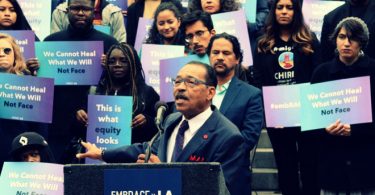
Tuesday night, there was an open forum at USC to discuss the break-up of an off campus party by more than six dozen LAPD officers, which has now become a high profile incident. Students, faculty, city and county officials and LAPD department members packed into a campus ballroom for the follow-up to several demonstrations and meetings this week regarding allegations of racial profiling by the LAPD against USC students of color.

If for some reason you missed the original story, last Friday night,, after responding to a simple noise complaint, seventy-nine officers, some in riot gear, made six arrests as they shut down a USC party attended predominantly by African Americans. Meanwhile, just across the street, LAPD officers handled a similar noise complaint against a group of mainly white party goers in what was reportedly a considerably more peaceful fashion.

Police maintain that the crowd at party two went inside and turned down the noise when asked, while many members of party one did not and an unspecified numbers threw objects at officers.

Among the students arrested was the first party’s host, Nate Howard, a bright and charismatic USC communications major who, in addition to being a student leader, is also a correspondent for mtvU, the creator of a production company called Brave Entrepreneurs, and has just shot a pilot for his own talk show. Several of the other kids arrested also turned out to be campus leaders.

Feeling unjustly profiled, amid the chaos, the party-goers began tweeting, Facebooking, and videotaping the LAPD encounter. Within hours, they had flooded various social media platforms, and organized a campus sit-in for the following day to raise awareness about what they characterized as unequal treatment by the LAPD that they insisted was not an isolated event.

Here’s a raw video of the 79 police officers (yes, the party-goers counted) taken by a student who had attended the party:

(NOTE: According to a source close to the department, there is an video, unreleased as yet, of officers in a radio car being hit by bottles and/or rocks.)

And another of an impassioned Nate Howard at the campus sit-in, at one point reciting what soon became the demonstrating students’ new call phrase: “We are scholars! Not criminals!”

During Tuesday night’s forum, attendees live-tweeted in a big way, and #USChangeMovement started trending. Here’s a link to the whole feed, but here are some of the tweets that stood out to us:

Frances Wang @FrancesWang_
Friday night,
I told an officer that he arrested USC scholars who will change the world. He laughed. Little did he know. #USChangeMovement

Evelina Weary ‏@evelinaweary
Alumni: “Why was DPS not the first responder
if this was a DPS registered party?” #uschangemovement #stopracialprofiling

Frances Wang ‏@FrancesWang_
Sarah, the host of the “white” party:
“These students weren’t treated with respect, my house was treated with respect.” #USChangeMovement

Neon Tommy ‏@neontommy
“This meeting is a waste of time if
you don’t go out to the community and engage your neighbors.” #USC #uschangemovement

Neon Tommy has an update from the forum. Here’s how it opens:

Los Angeles and campus police officials told dozens of students, who said they were victims of racial profiling by law enforcement, that authorities have concluded a strong response to a house party last weekend was not based on the race of students involved.

“We’ve looked at this really thoroughly, and there is no indication that it was race-based,” Los Angeles Police Capt. Paul Snell said Tuesday night. “Irrespective of what happened, what I would like to focus on is how we can move forward. Neither LAPD, neither DPS, neither the citizens of Los Angeles want this to happen again.”

And here’s another clip:

One was arrested on suspicion of interfering with police activity. The five others each face a misdemeanor charge. USC police chief John Thomas said he had previously been in contact with one of the students arrested, 20-year-old Rayven Vinson. He said seeing a photo of her being handcuffed hit him personally.

“This is about trust in the Department of Public Safety,” he said. “This is about you having trust in the department that’s providing protective services to you.”

L.A. Police Deputy Chief Bob Green called that first booking number devastating, saying there’s often little hope after that.

USC police chief Thomas said the university is working closely with police to make sure the students arrested are treated fairly. USC’s outgoing vice president of student affairs Michael Jackson said he’s advocating that the city attorney’s office drop the charges. Capt. Snell said the investigation is ongoing.

Here’s a short profile video of Rayven Vinson, one of the students arrested:

This next one is a first-hand account of yet another bright and well-spoken student from Santa Monica College, Anthony Stewart, who was detained Friday night:

We have a feeling this story isn’t going to go away soon. We’ll be keeping an eye on it.


MANY LATINOS AFRAID TO REPORT CRIMES, SURVEY SAYS

Latinos in LA and other cities are less likely to report crimes due to amped up immigration law enforcement and the threat of deportation, according to a new survey by the Lake Research Partners.

LA Times’ Brian Bennett has the story. Here’s a clip:

About 44% of Latinos surveyed said they were less likely now to contact police if they were victims of a crime because they fear officers will inquire about their immigration status or the status of people they know. The figure jumps to 70% among Latinos who are in the country unlawfully.

“There is fear that is really widespread,” said Nik Theodore, an associate professor of urban planning and policy at University of Illinois at Chicago and the author of the study.

The report, “Insecure Communities: Latino Perceptions of Police Involvement in Immigration Enforcement,” is based on a telephone survey of 2,004 Latinos in Los Angeles, Houston, Chicago and Phoenix. The results are scheduled to be released Tuesday.


CA SUPREME COURT UPHOLDS LOCAL RIGHT TO BAN POT DISPENSARIES

The CA Supreme Court ruled Monday that state law cannot stop cities and counties from banning medical marijuana dispensaries.

Here’s a clip from the AP story:

In a unanimous opinion, the court held that California’s medical marijuana laws — the nation’s first and most liberal — neither prevent local governments from using their land-use powers to zone dispensaries out of existence nor grant authorized users convenient access to the drug.

“While some counties and cities might consider themselves well-suited to accommodating medical marijuana dispensaries, conditions in other communities might lead to the reasonable decision that such facilities within their borders, even if carefully sited, well managed, and closely monitored, would present unacceptable local risks and burdens,” Justice Marvin Baxter wrote for the seven-member court.


MCJ MAKES IT ONTO WORST LOCKUPS LIST

In other news (and not all that surprisingly), Men’s Central Jail takes the number five spot on Mother Jones’ list of America’s ten worst lockups.


Photo used with permission from Twitter user and USC forum attendee @RiniSampath.

Posted in immigration, LA County Board of Supervisors, LA County Jail, LAPD, Marijuana laws, race | 2 Comments »

BETRAYAL OF TRUST – Part 1: Two Sheriff’s Deputies, Sons of Cop Fathers, Sue LASD for Threats, Retaliation, Conspiracy & More

April 29th, 2013 by Celeste Fremon


PROLOGUE

Last week two Los Angeles Sheriff’s Department deputies, Michael Rathbun and James Sexton—both the sons of law enforcement fathers—filed suit in federal court naming LA County, Sheriff Lee Baca, the former undersheriff Paul Tanaka, Lt. Greg Thompson, and a string of others.

The suit alleges retaliation, constitutional violations, malicious prosecution, conspiracy, harassment, direct threats—and a lot more.

It appears that Sexton and Rathbun tried every other possible route within the department to bring to light the alleged misconduct they said they witnessed, and to put a stop to the ongoing retaliation and agressive threats they reportedly experienced—but with no luck. So with much trepidation, the two brought this doozy of a lawsuit containing a laundry list of disturbing allegations, some of which we’ll cover in much more depth in the days to come.

For now here’s the overview:


RECKLESS ENDANGERMENT

To understand the whole of the 39-page lawsuit, which was filed on Tuesday April 23 by attorneys Brad Gage, Terry Goldberg, and Milad Sadr, all of Goldberg and Gage, it helps to remember that Rathbun and Sexton are the two deputies who were in the news some months ago, after a case they were working inside the jails allegedly got deliberately blown by their supervisor, Lt. Greg Thompson.

Sexton and Rathbun worked for the investigative unit inside the county jails known as Operation Safe Jails—or OSJ—an elite unit that develops intelligence sources and confidential informants among the inmates in order to better predict problems among the facilities’ gang populations.

The two, most particularly Sexton, were known for their facility at cultivating confidential informants—or CIs—who then yielded information that, in a great many cases, led to fruitful busts in the jails and, even more often, out in the street. Other units in the LASD, the LAPD and sometimes the FBI had all, at one time or another, been able to make use of Sexton and Rathbun’s information.

In the course of the investigation that would trigger the string of events leading to this lawsuit, the two had been told by a confidential informant, whom they had found in the past to be extremely reliable, that a deputy in Men’s Central Jail, whose name was Joseph Britton, was allegedly passing information—and possibly more—-to an inmate who was the primary white supremacist shot caller for the county jails. (Each racial group has its own gang hierarchy within each facility, and then an uber hierarchy in the county system as a whole.)

In return for his alleged favors for the white supremacist guy, who whose nickname is “Fritz,” Britton was allegedly getting expensive tattoo work for free by Fritz’s partner, who has a tattoo shop in the West Valley.

Sexton and Rathbun wrote up their detailed report on Britton, expecting their direct supervisor, Lt. Greg Thompson, to pass the information on to either Internal Affairs, or more likely, ICIB, the department’s internal investigative unit dealing with criminal matters, which would look into the allegations further.

Incredibly, Thompson did not pass the investigation up the line. Instead he took the un-redacted report—featuring Rathbun and Sexton’s name as investigators, and worse, the name of the confidential informant—and gave it to Britton, the deputy being investigated, plus others, thus effectively blowing the case to smithereens, and putting their CI potentially at lethal risk, since he was now in a position of being known as a snitch among Aryan Brotherhood types when he got out of jail. Being a snitch, in gang circles of any ethnicity, is traditionally a death sentence.

After Thompson leaked Sexton and Rathbun’s report, he reportedly did the thing that Sexton and Rathbun found the most unforgivable: He allegedly ordered one of his “acolyte” deputies to declassify their CI from a “K-10″ protected status, then to move him into the jail’s “general population,” meaning he was out among the masses, completely unprotected, thus his life would be immediately at risk—especially now that Lt. Thompson had liberally handed around the confidential investigative report that would unambiguously label the CI as a “snitch.” A rat.

Indeed, an attempt on the CI’s life was reportedly made almost immediately after the move: An inmate tried to shank him in the showers. The CI survived, according to Rathbun and Sexton, but only because he was larger and faster than his assailant.

The minute they heard of the CI’s exposure, Sexton and Rathbun pulled every string possible, and managed get their man back into a protected unit where they kept a close eye on him.

Stunned and furious at what they saw as their boss’s deliberate endangerment of their informant, Sexton and Rathbun went to internal affairs themselves and laid out what they knew.

That, according to the lawsuit, is when the threats and the retaliation began.

Months later, when an article about the Britton matter appeared in the LA Times, Rathbun and Sexton were subsequently called to testify in front of a federal grand jury.

After the feds entered the picture, the retaliation, the intimidation and the implicit and explicit threats became far more intense and frightening, according to the lawsuit.


SECOND GENERATION LAWMEN

Both Rathbun and Sexton are well-educated deputies, and second-generation cops, who appeared to come to the department with the idealistic view that the LASD was a place where they could make a positive contribution. Rathbun graduated from UC Santa Barbara, while Sexton began at West Point, finished up at the University of Alabama, and is now getting his master’s at USC.

Mike Rathbun is the son of 35-year LASD veteran, David Rathbun, now a reserve deputy. James Sexton is the son of Ted Sexton, the department’s newly hired Chief of Homeland Security, who left his longtime job as head of the sheriff’s department in Tuscaloosa County, Alabama, to come to work for his friend, Lee Baca.

In fact, when they had reportedly exhausted all other avenues, the lawsuit also alleges that each of the deputies talked multiple times personally with Baca whom they informed of everything that now forms the basis of the 39-page complaint. Sexton and Rathbun maintain they asked Baca for help, for advice as how best to proceed and, as matters deteriorated, they expressed fears for their personal safety.

Yet, it all came to nothing, they said.

Instead, the retaliation and threats against Rathbun and Sexton continued to get worse.


THE ANTHONY BROWN FACTOR: HIDING THE FEDERAL INFORMANT (FROM THE FEDS)

Even before the matter of Lt. Thompson, and the alleged endangering of the confidential informant, the lawsuit states that Rathbun and Sexton were ordered to participate in an “operation” that they quickly realized likely involved them in a crime—namely the hiding of FBI informant, Anthony Brown.

According to the lawsuit, the matter of moving Brown from place to place, clandestinely, inside the jail system, which LASD officials have claimed was done for Brown’s safety, was explicitly for the purpose of keeping him away from his FBI handlers and anyone from the U.S. Attorney’s office. Sexton and Rathbun know this because they were part of the team tasked with an extremely elaborate scheme of allegedly hiding Brown from any FBI agents or assistant US Attorneys, so that he could be debriefed by members of the sheriff’s department, who wanted to know for themselves what Brown had seen and heard that he was going to pass along to the Feds.

The lawsuit alleges that Lt. Thompson led the operation, but that he repeatedly stated to his troops that he did so at the direction of Paul Tanaka. Sexton and Rathbun describe multiple instances where Tanaka’s oversight was verified.

The deputies also report having knowledge of Sheriff Lee Baca being briefed on the operation.


WHITE POWER GANGS & RACIST DEPUTIES

Among its many disheartening allegations, the suit maintains that certain members of OSJ—the elit investigative unit within the LA County Jail system of which Sexton and Rathbun were members—have “an inappropriate relationship” with “various inmate gangs, particularly white supremacist gangs,” and that these department members use the inmate gangsters “as proxies or agents to retaliate against other LASD deputies or inmates” against whom they have a beef or grudge.

Sexton and Rathbun reportedly know this because they’ve witnessed it, and also because, once the Britton case came apart, they began being targeted.

The lawsuit outlines a quid pro quo system in which the Aryan Brotherhood-like types get special privileges that they are “otherwise legally precluded from.” In return, the white power gangsters do dirty work for a clique of racist deputies, a group in which Rathbun and Sexton say Thompson is included. (The suit also notes that Greg Thompson is a Viking from the same era as Paul Tanaka, and is reportedly very close to Tanaka. Thompson is named multiple times for wrongdoing in the famous class action lawsuit, Thomas v. the County of Los Angeles, settled in 1996 for $9 million.)

The lawsuit also alleges incidents in which OSJ deputies working in Men’s Central Jail would beat up inmates when it suited them, in one case, repeatedly harassing and injuring one of Sexton’s other confidential informants.

When Sexton reported the issues with his informant, having first vetted the claims to his own satisfaction, nothing was done. It was just bad judgement at most, he was told. Inmates lie.


THREATS & RETALIATION

The tale of the escalating threats and retaliation against Sexton and Rathbun that the lawsuit alleges is alarming and likely worth its own harrowing narrative. Here, however, is a sampling:

**In late February 2012, Sexton was “cornered” in a department office by two OSJ deputies, who were on duty in uniform, who told him that he and Rathbun “better shut up or else,’ about the Britton case.

**Also in February, Sexton was confronted around 1 am in the jails parking lot by a uniformed deputy who warned, his manner agressive, that he and Rathbun had better keep their mouths shut about the Britton case.

**At the same time, MCJ OSJ deputies referred to Sexton and Rathbun as “snitches” and told them that in moving “Fritz,’ the white power shot caller, the two were “fucking up their program.”

**In March 2012, Sexton conducted an audio-taped interview with a suspect in an unrelated case, in the custody facilities. Bizarrely, the audio was subsequently leaked and posted on YouTube. “Sexton’s ID was thus exposed, and his well-being placed in jeopardy.” Sexton asked Lt. Thompson to investigate the matter, but Thompson reportedly declined telling Sexton to ‘forget about it.”

**In April 2012, Rathbun, who had been struggling with drinking to cope with increasing job stress, had a bad night in which he drank a lot, and got into a “fender bender,” and was charged with a misdemeanor DUI. The video of the arrest, was anonymously posted on the LASD’s intranet network.

**“White power” literature was left on the front porch at Rathbun’s home in a manner that was seen as a threat. At the same time, white power inmates in MCJ began referring to Rathbun and Sexton as “race traitors.”

**The lawsuit reports several similar and aggressive warnings of “you better…or else” from OSJ deputies, including Lt. Thompson’s son, Matt Thompson.

**In April 2012, right before Sexton was due to be interviewed by Internal affairs about the Britton incident. Lt. Thompson himself called Sexton at home and asked if he was going to talk to IA and ICIB. Sexton said he was. Thompson then reportedly abruptly hung up.

**The threats continued, and included awkward meetings with Thompson who demanded to know what Sexton and Rathbun had told LASD personnel in this or that interview.

**In May, Thompson called Sexton into his office. “Have you been calling your dad back home about this?” he wanted to know. Yes, sir, said Sexton. “If I were you I’d quit telling your dad war stories about what’s going on in this jail.”

**Often now, according to the lawsuit, the threats came with explicit mentions of bodily harm.

** After Sexton and Rathbun were subpoenaed to testify in front of a grand jury, and indeed testified, two deputies cornered Sexton, one of them, Lt. Greg Thompson’s son, Matt Thompson, wanting to know what they’d talked about at the grand jury.

**In June, after Thompson was removed from the unit, two deputies announced at a unit party that whomever caused “the boss” to be transfered would “answer” for their actions.

**Sexton has allegedly been subject to frivolous retaliatory investigations by Internal Affairs, each time coming to nothing.

**And then there is the matter of Rathbun’s DUI, which was quietly upped to a felony, which would have likely meant prison time, although, according to the lawsuit, there was no factual basis whatsoever for the escalation of charges. The suit alleges that the charges were raised at the behest of LASD supervisors.

**Rathbun’s car was vandalized on LASD property.

**Sexton found men in an unmarked car across the street from his house, watching his home, attempting to take pictures. When Sexton approached them, they claimed to be “insurance inspectors,” but reportedly sped away when he asked for ID.

**In the summer of 2012, Rathbun was suspended without pay for the DUI, but assured by Baca that he would be able to return with no harm to his career.

**In September 2012 Sexton needed to make a work-related visit to the department’s Temple Station, where Thompson had been transferred after an LA Times article precipitated the opening of an IA investigation into his actions regarding the Britton matter. Upon arriving, however, Sexton was intercepted by Temple station’s Sgt. Larry Mead, who reportedly relayed a message from Thompson that Sexton should leave the premises, “to prevent an incident.”

**In late 2012, a high-ranking supervisor expressed concern that Sexton and Rathbun’s lives might be in danger.

**in late 2012, “Rathbun discovered that LASD personnel, including Detective Perkins,” were the ones responsible for escalating his DUI misdemeanor to a felony. (The charge was eventually dropped again by the DA to a misdemeanor, and the case settled.)

**In March of 2013,” reports the lawsuit, “Michael Rathbun was recommended for termination,” although the DUI was his first infraction, and according to a document obtained by WLA, at least 5 other LASD deputies and 4 non-sworn LASD staff members also got DUI’s in the first two quarters of last year, for which they received only 15 to 30-day suspensions.


BETRAYAL OF TRUST, Part 2 coming soon.


UPDATE:

Posted in jail, LA County Jail, LASD, race, Sheriff Lee Baca | 34 Comments »

Supremes & the Voting Rights Act…Kids Witnessing Violence…And More

February 27th, 2013 by Celeste Fremon


THE SUPREME COURT COULD STRIKE DOWN PART OF VOTING RIGHTS ACT

The U.S. Supreme court will hear arguments Wednesday about a particular part of the voting rights act that conservatives see as intrusive to state’s rights and liberals see a crucial to prevent state laws aimed at making it harder for minorities to vote.

Lawrence Hurley at Reuters explains the central issues that will be heard on Wednesday. Here’s a clip:

The Supreme Court on Wednesday will consider whether to strike down a key provision of a federal law designed to protect minority voters.

During the one-hour oral argument, the nine justices will hear the claim made by officials from Shelby County, Alabama, that Section 5 of the Voting Rights Act is no longer needed.

The key issue is whether Congress has the authority under the 15th Amendment, which gave African Americans the right to vote, to require some states, mainly in the South, to show that any proposed election-law change would not discriminate against minority voters.

Conservative activists and local officials in some jurisdictions covered by the provision have long complained about it, saying that it is an unacceptable infringement on state sovereignty.

Hans von Spakovsky, a senior legal fellow with the conservative Heritage Foundation who formerly worked in the Justice Department’s civil rights division, said that the “terrible history” that warranted Section 5′s intrusion on state authority was over.

Adam Liptak at the NY Times has a Q & A that lays out the basic facts of the Voting Rights Act, its history, its importance, and the heart of Wednesday’s question.


ALEX KOTLOWITZ TALKS ABOUT THE PRICE OF PUBLIC VIOLENCE

Author/journalist Alex Kotlowitz has written a must-read op ed for Sunday’s NY Times that I didn’t want you to miss.

Kotlowitz wrote the award-winning classic, There are No Children Here, and was one of the reporters on This American Life’s 2-part series on the affect of violence on the students of Harper High School in Chicago.

The Op Ed is about the effects that witnessing violence has on anybody, and in particular kids who live in high violence areas.

As he makes his point, Kotlowitz uses facts and figures from his home city of Chicago, where violent crime is way up right now. But the same principals he talks about certainly hold true in Los Angeles. Ditto Oakland, and so on.

Anyway, here’s a clip from Kotlowitz’s essay.

EVERY year, the Chicago Police Department issues a report with the macabre title “Chicago Murder Analysis.” It’s a short but eye-opening document. Do the calculations and you realize that in the past 15 years, 8,083 people have been killed, most of them in a concentrated part of the city. There’s one particularly startling revelation that gets little notice: in 2011, more than four-fifths of all murders happened in a public place, a park, an alleyway, on the street, in a restaurant or at a gas station.

When Hadiya Pendleton, the 15-year-old public school student and band majorette who just a week earlier had performed at President Obama’s inauguration, was killed on Jan. 29, she was standing under an awning in a park with a dozen friends. They all saw or heard it when she was shot in the back. One of them, in fact, was wounded by the gunfire. Which brings me to what’s not in the “Chicago Murder Analysis”: Over the past 15 years, according to the University of Chicago Crime Lab, an estimated 36,000 people were shot and wounded. It’s a staggering number.

We report on the killers and the killed, but we ignore those who have been wounded or who have witnessed the shootings. What is the effect on individuals — especially kids — who have been privy to the violence in our cities’ streets?

I ask this somewhat rhetorically because in many ways we know the answer. We’ve seen what exposure to the brutality of war does to combat veterans. It can lead to outbursts of rage, an inability to sleep, flashbacks, a profound sense of being alone, a growing distrust of everyone around you, a heightened state of vigilance, a debilitating sense of guilt. In an interview I heard recently on the radio, the novelist and Vietnam veteran Tim O’Brien talked about how the atrocities and nastiness of battle get in your bones. The same can be said for kids growing up in Hadiya’s neighborhood.

The ugliness and inexplicability of the violence in our cities comes to define you and everyone around you. With just one act of violence, the ground shifts beneath you, your knees buckle and all you can do is try the best you can to maintain your balance. But it’s hard.

There’s lots more, and I recommend reading the whole thing. But here’s one more clip from the end of Kotlow essay:

In the wake of Hadiya Pendleton’s shooting, we’ve talked about stiffer gun control laws, about better policing, about providing mentoring and after-school programs, all of which are essential. But missing from this conversation is any acknowledgment that the violence eats away at one’s soul — whether you’re a direct victim, a witness or, like Anita Stewart, simply a friend of the deceased. Most suffer silently. By themselves. Somewhere along the way, we need to focus on those left behind in our cities whose very character and sense of future have been altered by what they’ve experienced on the streets.


MALIBU/LOST HILLS SHERIFF’S STATION TAKES PART IN “ACTIVE SCHOOL SHOOTER TRAINING

Early this past Saturday, around 30 Los Angeles Sheriff’s Department deputies and supervisors from Malibu/Lost Hills Station engaged in an “active school shooter” training on site at Topanga Elementary School in Topanga Canyon.

The LASD teams were joined by personnel from other agencies like the Malibu Search and Rescue Team, writes David Katz for the Malibu Times.

The training was part of the Sheriff’s Department’s ongoing efforts to prepare and train for events involving active shooter incidents at schools or other locations.

More than 30 officers and deputies cycled through several training scenarios involving armed shooting suspects with multiple adult and child victims.

Department sources say such exercises with “training scenarios’ are very valuable in fostering cooperation and communication between agencies likely to be called out, as well as giving officers practice in these high intensity emergencies and their specialized challenges.

(Full disclosure: Topanga Elementary where my son went to elementary school. I’m only sorry I wasn’t there on Saturday morning to observe.)


Photo of LBJ signing the 1965 Voting Rights Act, by Yoichi Okamoto, courtesy of the Lyndon Baines Johnson Presidential Library

Posted in campus violence, PTSD, race, race and class, racial justice, Violence Prevention | No Comments »

South LA Community Meeting on LAPD & Dorner…Paul Tanaka Running & Not Running for Gardena Mayor…and Facts Vs. Fears on Realignment

February 25th, 2013 by Celeste Fremon


Last Wednesday night, a gathering of South LA community members met with LAPD Chief Charlie Beck
and several members of his command staff to discuss the concerns, angers, old wounds and fears relating to the Los Angeles Police Department that the situation with Christopher Dorner had brought to the surface. The meeting was moderated by Skipp Townsend, head of 2nd Call, a non-profit that helps parolees, at risk youth and others turn their lives around.

When notice of the meeting went out, community organizers used Facebook to urge attendance: “Get involved or don’t complain,” they said.

LA Times columnist Sandy Banks was at the event and wrote an unusually sane and thoughtful story on the myriad complex emotions that swirl in the wake of the Dorner nightmare, many of which were talked about last Wednesday night.

Here are some clips from Banks’ story:

I expected fireworks in South Los Angeles this week, when LAPD Chief Charlie Beck showed up at a community meeting to talk about Christopher Dorner, the ex-cop turned killer whose manifesto cast the department in an ugly light, resurrecting decades of buried wrongs.

The crowd at the Vermont Avenue community center was small, about 100 people. But the line to speak stretched from the stage to the back of the room. Some came for answers, some just to vent.

There were stories of ugly street stops and police harassment. Half a dozen people — black, white and Latino — said they’d had family members injured or killed by cops. An old man carried a poster of Dorner. A young man told Beck that the LAPD’s legacy runs so deep, “babies cry when they see your uniform.”

They had read Dorner’s manifesto, which blamed his firing from the LAPD on racists, liars and cowards. There were nods all around when one man declared, “I don’t defend what Dorner did, but like many in the community, I believe what he said.”

But no voices were raised, no insults hurled. Nearly everyone prefaced their comments to Beck with some version of “thank you for coming.”

[BIG SNIP]

A lot has been made of the ways the LAPD has changed since Rodney King and Rampart. The institution is more accountable, with video cameras in patrol cars and officers equipped with microphones. And the ethnic makeup now reflects the city’s demographics: 43% of officers are Latino, 35% white, 12% black, and 9% Asian American. Twenty percent are women.

Still, it’s unrealistic to believe that the LAPD has cleared its ranks of bullies and bigots.

Beck acknowledged that in South L.A. this week. “You will never have a perfect department,” he said. “We hire from the human race and we hire the best people we can, and sometimes they make mistakes.”

Some officers can be redeemed through discipline and training, but those with a “malignant heart” have to be let go, Beck said.

But how do you see into an officer’s heart and who determines its darkness? And how does an officer wind up fired for reporting misconduct?

[BIG SNIP]

Clearly, given his actions later, his was a “malignant heart.” Dorner was unfit to be a police officer.

But the account of his termination is troubling enough that it makes me wonder if the process was used to seek truth or simply to root out a troublemaker.

It looks like a Catch-22: Officers are subject to discipline for not reporting misconduct. But if you make the claim and it doesn’t stick, you can be fired because your bosses doubt you.

That’s a message with the potential to punish a whistle-blower. It seems to validate the “no snitching”

[BIG SNIP]

I can’t imagine how painful it must be for the LAPD’s rank and file to absorb this blow to the family. I understand the rumbling among officers who feel that giving any credence to Dorner’s claims risks turning a maniacal killer into some sort of martyr.

But I’ve also heard from officers who feel shamefully relieved that Dorner expressed publicly the frustrations some have been carrying privately for years.

Read the rest.


LASD UNDERSHERIFF IS RUNNING & NOT RUNNING, CAMPAIGNING BUT NOT CAMPAIGNING FOR MAYOR OF GARDENA

For the last few months, LASD Undersheriff Paul Tanaka, who also happens to be the mayor of Gardena, has been not running for a third term as mayor, although he didn’t manage to make the not-running decision until he’d already put his name on the ballot.

More recently, he has modified his stance and now says that he isn’t going to campaign, and doesn’t want to run, but will be happy to accept the job as mayor if people really, really, really want him so much that they can’t help but elect him.

(There are two other candidates. One who is on the ballot as well as Tanaka. Another is a write in who didn’t sign up originally because he thought Tanaka was running.)

A few days ago, Tanaka reiterated this message that he is not campaigning to Daily Breeze reporter Sandy Mazza. And then he went on to list for Mazza all the reasons one might want to vote for him. To wit:

Tanaka’s main argument for re-election is his record. Since he first captured the mayor’s seat in 2005, the city has added about 35 police officers, balanced its budget, put away $10 million in a rainy day fund, and negotiated an affordable repayment for a crippling $26 million debt racked up from two failed city initiatives in the 1990s.

“My record speaks for itself,” Tanaka said. “The decision for people to make is, `Do you like what you’ve seen in the last eight years?’ We’ve erased the deficit, gotten back in the black, and increased our surplus.”

Also, although Tanaka isn’t running or campaigning, his good friends at the Gardena Police Department are raising money and campaigning for him, according to Mazza.

WitnessLA has reported extensively on Tanaka’s longstanding habit of soliciting/accepting campaign contributions for his mayoral campaigns from Los Angeles Sheriff’s department members whose careers he has had the power to affect. These revelations have, in turn, been a cause for concern and criticism by the members of the LA County Board of Supervisors, the Citizens Committee on Jail Violence, and finally—indirectly—by Sheriff Baca.

And then there is the LA Times’ recent story about an odd incident in which the sheriff’s department, namely Tanaka, used the Gardena PD to surreptitiously ship a bunch of bullet proof vests to Cambodia.

So, what does all this have to do with the Gardena mayor’s race? Oh, who knows. Likely nothing. It is simply that, as the undersheriff has demonstrated himself to be a man who often has a purpose for his actions other than what is publicly stated, it hard not to wonder what all this running/not running business is really about.


CRIME CONTINUES TO DROP IN LOS ANGELES AND MOST CALIFORNIA COUNTIES, EVEN THOUGH CRITICS INSIST THAT THAT REALIGNMENT IS CAUSING A RISE IN CRIME

On Sunday, the San Jose Mercury News ran an op ed that compares some of the realignment fears with facts.

Here are a couple of clips:

There are two major complaints: One is that crime rose as realignment cut the inmate populace by more than 24,000. The other is that some criminals are being released earlier than before the program began in October 2011, in part because local jails in a few counties are overcrowded.

A typical gripe comes from Tyler Izen, president of the Los Angeles Police Protective League, the state’s largest police union. “Our members are terribly concerned that we are allowing people out of prisons who are likely to recommit crimes and victimize the people of our city,” he said in a telephone interview.

He claimed probation departments have lost track of some former prisoners, but could offer no specific examples. “All I have is anecdotal information,” he conceded.

It turns out that only one of those big gripes has any proven merit: In a few counties, Fresno being a prime example, prisoners are often released after serving minimal jail time. But sheriffs and the state Department of Corrections insist the releases never involve violent or sexual criminals and that ex-convicts get the same level of parole and probation supervision they did before.

As for crime being up? Well, in LA violent crime isdown for the 10th year in a row, as the essay points notes:

….dropping 8.2 percent to a total of 18,293, with significant decreases in robbery and aggravated assault. There were 152 gang-related homicides — the fewest in more than 10 years.

But property crime was up slightly in L.A., by 0.2 percent, with Police Chief Charles Beck attributing the uptick to a 30 percent increase in cellphone thefts. Beck said some of the small increase in property crime might be due to realignment.

In surrounding Los Angeles County, homicides were at 166, the lowest number since 1970,

Murders are up in Oakland, San Jose and San Francisco—which could be due to realignment.

Or not.

“Taken together, those three cities lost more than 850 police officers to budget cuts in the past three years, which may help explain some of their homicide increase.

The other dozen reporting cities in the region had 24 percent fewer murders during that period, and, overall, Bay Area slayings remain well below historic highs.

Let us hope that sometime in the next year we will have the results of some kind of study that involves serious numbers crunching and analysis to tell us—from a fact-based, rather than fear-based perspective—exactly how AB109 has affected the state and counties.

Joan Petersilia’s team at Stanford University is, we know, working on study. But it seems to be a slow process.


Photo/Najee Ali

Posted in Charlie Beck, LAPD, Police, race, racial justice, Realignment | 8 Comments »

Chief Charlie Beck to Hold Press Conference About Dorner Case…and More

February 19th, 2013 by Celeste Fremon


BECK PRESS CONFERENCE TUESDAY MORNING

Los Angeles Police Department Chief Charlie Beck is holding a press conference Tuesday at 9 am to “provide an update to the Christopher Dorner case and on the reopening of the investigation.”

Along with Beck, LAPD Captain Phil Tingirides plus his wife, Sergeant Emada Tingirides, will “address the media with their experience as protected employees during the Dorner manhunt.”

To refresh your memory, Captain Tingirides sat on the Board of Rights panel that recommended Dorner’s dismissal and was one of the dozen department members whose families were threatened most specifically in the “manifesto” that has been attributed to Christopher Dorner. (There were upwards of 50 officers and their families who were considered at risk, but with some, the risk assessment was considered to be much higher. Tingirides was one of those at the high risk end.)

Interestingly, Tingirides, who is white, is married to an LAPD officer (Emada Tingirides) who is black—a fact that one imagines was not lost on those planning the press conference, given the intense and painful conversations about the LAPD and racism that the whole Dorner matter has brought back to the surface. (Emada Tingirides worked at the department’s Harbor division with Dorner.)

In any case, it is a good thing that Beck is having press conference at this juncture. (I understand there was a contingent inside the department advising him against it.) Now let us see what comes of this morning’s discussion.

It is also encouraging to note that the chief and other command staff members have made a point of scheduling upcoming open meetings in South LA to hear what community members have to say about about the department, and what they want to see changed.

NOTE: While we wait for the outcome of the press conference, here’s this morning’s interview between Phil and Emada Tingirides and CBS’s John Miller, who was one of the highest ranking civilians at the LAPD under Bill Bratton. We learn, among other things, that some of the South LA’s gang members and former gang members offered to act as a protection detail for the Tangirides couple and their six kids, when the Dorner threat was announced. (Tangirides kindly but firmly turned the homeboys down.)

UPDATE: I’m snowed under with another project, thus I want to refer you to reports from the press conference by: KPCC.…. The LA Times The Daily News.


LAPD LIEUTENANT (& FORMER IA INVESTIGATOR) SAYS DEPARTMENT SHOULD ABOLISH INTERNAL AFFAIRS, AND THAT COPS SHOULD NOT BE INVESTIGATING COPS IF THEY WANT TO GAIN THE TRUST OF THE COMMUNITY

In an Op Ed for the Washington Post, LAPD Lieutenant Sunil Dutta, who worked for LAPD’s Internal Affairs (among other postings), says it’s time to have civilians—not cops—investigate the police. And he explains why he thinks this is right for both the community and for the Los Angeles Police Department.

Here are some clips:

….The department’s problems aren’t all in the past, either: In November, a jury awarded former officer Pedro Torres $2.8 million after finding that officials retaliated when he verified claims about an allegedly racist supervisor. During the past decade, 17 officers have won million-dollar-plus verdicts in lawsuits claiming harassment, discrimination and retaliation. African American officers, including some supervisors I’ve spoken with, say in private that they don’t feel like they are part of the system and don’t trust it.

[BIG SNIP]

I worked as an internal affairs investigator in the LAPD for about three years. When I visited police divisions to look into complaints against officers, I was usually greeted by the same question: “Who are you going to burn today?” Officers often believed that internal affairs was out to get them on flimsy charges.

At the same time, when I interviewed community members who had filed complaints against officers, I was disappointed to learn that, despite my reassurances and best efforts to conduct impartial inquiries, many complainants believed that a fair investigation was simply not possible. Nor do misconduct investigations satisfy a skeptical public. If an officer is exonerated, the community often believes that malfeasance is being covered up.

Police serve the community — any concerns about their integrity must be transparently, expeditiously and judiciously resolved. Relying on cops to police cops is neither efficient nor confidence-inspiring.

The solution? Abolish internal affairs units and outsource their work to external civilian agencies.

Police have slowly started to incorporate civilian oversight in their misconduct investigations. For example, the LAPD’s office of inspector general has oversight over the department’s internal discipline. Yet, while the inspector general’s staff receives copies of every personnel complaint filed and tracks and audits selected cases, it does not have the authority to impose discipline. Nor do most civilian review boards, which are not empowered to conduct independent investigations. This leads detractors to say that such boards are ineffectual.

Police have long resisted external oversight….

Anyway, read on.

And for more on Sunil Dutta, who is quite an interesting guy (whose writing has appeared in the past here at WLA), I refer you to Wikipedia.


CAPT. BILL MURPHY, HEAD OF THE LAPD’S DORNER PROTECTION DETAIL, TALKS TO HIGHLAND PARK PATCH

Ajay Singh of the Highland Park Patch, snagged a Q&A with Captain Bill Murphy, the LAPD Northeast Division commander who ended up being in charge of providing police protection to officers and their families targeted by Christopher Dorner.

In this interview with Capt. Murphy we learn such things as the fact that the department briefly considered temporarily relocating the threatened families to a military base, but quickly realized the impracticality—what with kids and schools and…”they had pets and what not.”

There are lots of other interesting nuggets of that nature.

Oddly what Singh did not appear to ask Murphy is about the matter of shooting the two newspaper delivery women.

I’ve interviewed Bill Murphy many times in the past and have always found him to be a straight shooter unafraid of treating the press like grown ups, and who, when he can’t talk about something says so, and why, without any kind of dodging.

So I wondered at the oversight.

In any case, the interview is still quite worth reading.


LA DISTRICT ATTORNEY’S OFFICE AND ALTERNATE PUBLIC DEFENDER OPEN INVESTIGATION INTO PASADENA COPS AFTER JUDGE DECLARES MISTRIAL IN A MURDER CASE AND…LOTS, LOTS MORE

Okay, this ongoing story about members of the Pasadena Police Department’s homicide squad is the brewing police misconduct scandal that seems to be getting lost amid...well….everything else. But it’s been hitting the press intermittently since last summer, with Pasadena Star-News’s Brian Charles taking the lead in the reporting.

Now the LA DA’s office has taken action, as has the alternate public attorney’s office, after Judge Larry Fidler declared a mistrial in a murder case, and evidently admonished Detective William Broghamer and Officer Kevin Okamoto for their “egregious” conduct during an 2007 homicide investigation.

Charles reports:

A defense attorney for one of the defendants in that case said the county’s twin investigations will likely expose deep rooted corruption.

“They shouldn’t have a homicide department,” Attorney Andrew Stein said Thursday. “The department needs to be cleaned out from the top-down. I don’t understand how anyone could allow this culture to exist.”

So what exactly have Detectives Broghamer and Okamoto and another of their colleagues, a Detective Keith Gomez, been accused of doing?

Here’s another clip from Charles’ story:

Earlier this month [Pasadena PD Chief] Sanchez placed Okamoto on paid leave after [Judge] Fidler said the officer hid exculpatory evidence from defense attorneys. Broghamer was placed on desk duty after the same judge admonished him for his conduct during an interrogation in which he threatened to take a witnesses’ child away from her if she didn’t recant earlier statements.

Under duress, the woman changed her testimony; Okamoto signed paperwork authorizing the woman to receive $6,450 in taxpayer dollars for “relocation expenses.”

[SNIP]

Okamoto, Broghamer and Detective Keith Gomez have been the subject of complaints filed by attorneys, witnesses, jurors and suspects. Allegations of kidnapping, assaults, death threats, soliciting of bribes, evidence suppression and malfeasance are contained within the complaints.

You might want to read that last sentence again.

To further elucidate, here are some links to stories that give windows into a few of the jaw-dropping accusations against the three detectives:

Here for example, is the story about the three detectives allegedly kidnapping and beating a witness who wouldn’t say what they wanted him to say regarding a case they were investigating.

And….here’s the story in which a criminologist reports that he was asked by Detective Okamoto to withhold evidence from the defense and “mislead” the defense attorney.

And…here’s the thing about Detective Okamoto allegedly forcing a female witness to change her testimony about a murder defendant, using a whole series of convincing threats and a quid pro quo-ish set up that looks an awful lot like a bribe.

We’ll check in on this story in the future, so stay tuned.


JUDGE WHO STRUCK DOWN CALIFORNIA’S GAY MARRIAGE BAN SPEAKS OUT

As the prospect of the Prop 8 case being argued before SCOTUS a little over a month away, Howard Mintz of the San Jose Mercury News writes about his intriguing interview with former San Francisco Federal Judge Vaughn Walker who originally heard the Prop 8 legal challenge.

Here’s a clip:

On a May day in 2009, Vaughn Walker was going through one of his weekly routines as a federal judge, reviewing a stack of new lawsuits assigned to his San Francisco chambers, when one case caught his eye: Perry v. Schwarzenegger.

At the time, Walker had no inkling that history might rest in those pages, that one of the most important legal collisions in the nation over same-sex marriage might hang in the balance. In fact, at first, all Walker noticed was then-Gov. Schwarzenegger’s name.
But it did not take long for the veteran chief judge, himself quietly but openly in a longtime gay relationship with a doctor, to realize that he had inherited the legal challenge to Proposition 8, California’s ban on same-sex marriage. The silver-haired judge with the iconoclast’s reputation would be center stage in the gay marriage controversy.

“That’s when I had the —-’Oh (my)’ moment,” Walker told this newspaper during an interview last week, recalling that he was already mulling retirement when the lawsuit landed on his desk.
The case temporarily took retirement off the table for Walker. And now the Proposition 8 showdown has reached the U.S. Supreme Court, which will hear arguments on March 26 and, to some extent, review Walker’s handiwork before ruling by June. Walker, after conducting an unprecedented trial, in 2010 declared the state’s gay marriage ban unconstitutional, saying the law had no social justification and singled out same-sex couples for discrimination.

A federal appeals court agreed with Walker, although it took a much narrower approach in invalidating Proposition 8. Still, Walker’s role has shaped the nearly four-year legal battle over same-sex marriage rights in California.

Read on. It’s good stuff.

Posted in Charlie Beck, LAPD, race, race and class, racial justice | 14 Comments »

2 More Dorner Stories …Does Baca Play Favorites With Concealed Weapon Permits?….Foster Care & More Dead Kids….Gun Advocates & Death Threats

February 15th, 2013 by Celeste Fremon


DORMER, THE LAPD AND A PSYCHOLOGICAL “CEMETERY FULL OF GHOSTS”

“We’ve got a cemetery of ghosts from LAPD’s past raised by this tragic—beyond tragic— catastrophe,” said civil rights attorney Connie Rice, when she and LAPD expert, Joe Domanick, associate director of the Center on Media Crime and Justice, and author of the definitive history of the LAPD, “To Protect and to Serve,” were interviewed by Madeleine Brand on KCET’s So Cal Connected about what the Dorner nightmare means for the LAPD going forward.

Both Rice and Domanick have looked into the LAPD deeply over the years, and thus have much to add to the developing conversation. Here’s the link.


LA WEEKLY REPORTS THAT SHERIFF LEE BACA SEEMS TO PLAY FAVORITES WHEN HE GIVES OUT CONCEALED CARRY PERMITS

Gene Maddeus at the LA Weekly reports, based on documents obtained by the Weekly through the public records act, that Sheriff Lee Baca approves very few concealed weapons permits but those he does approve are likely to be for his friends and/or his donors.

Here’s a clip from the story:

The L.A. County Sheriff’s Department is known in gun-rights circles for being stingy with concealed-weapons permits. Sheriff Lee Baca has total discretion over who is allowed to get a permit, and he hasn’t given out many.

As of May 2012, only 341 people had been granted them, according to sheriff’s records. Compare that with the San Bernardino County Sheriff’s Department, which had 1,754 permit holders in 2011, despite a population of just 2 million people to L.A.’s 10 million. The Kern County Sheriff granted even more, with 3,564 permit holders in a population of 800,000 people.

In L.A. County, records show, most of the permits go to judges and reserve deputies. But there is another group that seems to have better luck than most in obtaining permits: friends of Lee Baca. Those who’ve given the sheriff gifts or donated to his campaign are disproportionately represented on the roster of permit holders.

Chuck Michel, a gun-rights attorney who has pushed for greater access to concealed-weapons permits, says practices in many “anti-gun” jurisdictions are “corrupted by favoritism and cronyism.”

Michel had not looked in depth at L.A. County’s practices, but the Weekly did. Last year, the Weekly filed a public records request for all 341 active concealed-weapons permits granted by the Sheriff’s Department — as well as a list of the 123 people who applied for concealed weapons over an 18-month period but were denied….

And here’s where you can find the list of permit holders that the Weekly acquired.


MORE ON THE DORNER SEIGE AND THE USE OF “BURNERS”

The LA Times Joel Rubin and Andrew Blankstein have the best story I’ve read thus far on the ongoing question of whether the San Bernardino Sheriff’s Department SWAT team deliberately set fire to the cabin where Dorner was barricaded.

The department has said no, then declined to comment on the matter further. But based on the Times’ and other reporting this seems a bit disingenuous. Whether or not it was the stated intent, it was the all but guaranteed outcome after sending in seven highly incendiary tear gas devices into a mountain cabin.

Rubin and Blankstein find expert opinions on both sides of the question of whether the move was justified. In the end, however, one is left with the picture of an extremely difficult and deadly situation with no perfect choices after Dorner did not respond, except with gunfire, to repeated calls to surrender.


CONFIDENTIAL COUNTY REPORT SHOWS AN INCOMPETENT AND OVER BUREAUCRATIZED FOSTER CARE SYSTEM THAT RESULTED IN 13 RECENT KIDS’ DEATHS WHEN DCFS WORKERS’ MADE INCOMPREHENSIBLY BAD DECISIONS

Jason Song and Garrett Therolf report for the LA Times. Here’s a clip:

A stifling bureaucracy and inept workforce have crippled Los Angeles County’s child protective agency, resulting in a system that allowed children to remain in unsafe homes, sometimes to die at the hands of their caretakers, according to a confidential county report.

The investigation, conducted by an independent counsel for the Board of Supervisors, looked at 15 recent child deaths and a torture case. In all but two instances, investigators found that casework errors began with the agency’s first contact with the children and contributed to their deaths.

The report is the harshest assessment of the Department of Children and Family Services in recent memory, echoing complaints from child advocates that the county has rejected for years.

Investigators largely blamed the department’s problems on its decision to place its least experienced social workers in its most crucial job: assessing dangers to children. Many of those workers — facing a total of 160,000 child abuse hot line calls each year — are “just ‘doing their time,’” according to the report.

Supervisors are poorly qualified and often disregard policy, creating a situation akin to “the blind leading the blind,” with workers rarely held accountable for “egregious” errors, the report said.

The result has been deaths that might have been prevented had social workers taken basic steps to assess the risks.

Here’s a link to the report that the LA Times obtained.

In short, this is an agency in need of an overhaul. We very much hope that Philip Browning, the newest DCFS chief who came on just as the report was being completed, is up to the task of making the “wholesale changes” the report recommends. Browning was picked because he’s known as a solid nuts and bolts guy capable of turning things around.

He cautions that this will not be a quick fix.

No kidding.


GUN ADVOCATES & DEATH THREATS: SENATOR LELAND YEE GETS A THREAT “LIKE NO OTHER.”

On Thursday, State Senator Leeland Yee, held a press conference to announce an extremely chilling threat against his life. Rather than paraphrase, let me quote from his statement on the matter:

Four weeks ago, I received an email to my Senate account detailing a very explicit threat on my life. The author of the email specifically stated that if I did not cease our legislative efforts to stop gun violence that he would assassinate me in or around the Capitol. He stated that he was a trained sniper and his email detailed certain weapons he possessed.

This threat was unlike any other I had ever received. It was not a racist rant on my ethnicity or culture, but instead it was very deliberate and specific. As a psychologist, I was deeply concerned by the calculating nature of this email.

My Chief of Staff immediately forwarded the email to the Senate Sergeant at Arms and the CHP to investigate.

As you know, law enforcement made an arrest on Tuesday and executed a search warrant of the suspect’s home in which they found illegal weapons and bomb-making materials. I have no other details regarding this case and all such questions should be directed to the CHP.

With that said, I want to make it crystal clear – these threats and any others will not deter me and my colleagues from addressing the critical issues surrounding gun violence. This case is very troubling and only further demonstrates the need to address this epidemic.

The San Francisco Chron has more on the story.

EDITOR’S NOTE: Because of the nature of what I’ve reported on over the years, I’ve gotten more than my share of angry letters and the occasional not-so-veiled threat. But nothing approached the flood of hatred and genuinely scary threats I got back the spring of 2000 for an essay I wrote for MSNBC (where I was, at the time, a regular columnist) about my experience bringing my then-fourteen year old son to the so-called Million Mom March for gun control.


AND WHILE WE’RE ON THE TOPIC, NEW REPORT SAYS LA RESIDENTS APPLY TO BUY 200 GUNS A DAY

Yikes.

Rick Orlov of the Daily News has the story. Here’s a clip:

Los Angeles residents apply to buy 200 guns a day, an alarming number making it difficult to get weapons off the street, City Attorney Carmen Trutanich said in a preliminary report on gun purchases in Los Angeles.

“With Angelenos buying an average of nearly 200 firearms every day, thousands every month and tens of thousands every year, I will do everything in my power to keep guns out of the hands of people interested only in destroying the lives of children, families and police officers,” Trutanich, who is in a close re-election race, said in a written statement.

The results are based on letters his office began sending out in December during the 10-day waiting period for people buying guns. The letters reminds gun owners to keep the weapons safe and report when weapons are lost or stolen.

If we can stop just one person from buying a gun who is prohibited from possessing a weapon, or stop someone from buying guns for felons or the mentally ill, then perhaps we have also stopped another senseless tragedy,” the letter said.

The letters were sent out as a follow-up to a study by the RAND Corp. that said 50 percent of people will voluntarily comply with local laws if they are informed of the requirements.

Our intent was to make them aware of the laws and what they have to do under the law,” Trutanich said in an interview. “Our purpose was to get more compliance.”

Posted in Foster Care, guns, LAPD, LASD, race, racial justice, Sheriff Lee Baca, State government, State politics | 17 Comments »

LAPD Chief Beck’s Plans To Reopen the Dorner Dismissal Case Should Be the 1st Step. More Concrete Steps Must Follow

February 10th, 2013 by Celeste Fremon


As most of you have doubtless heard by now,
in an interview with CBS’s Pat Harvey on Saturday, Los Angeles Police Department Chief Charlie Beck said that he would reopen the case that led to Dormer’s termination.

(You also I’m sure know that a $1 million reward is being offered for information leading the capture and conviction of Dorner.)

Reopening Dorner’s case is an important move. Despite vast improvement, the toxic elements of the bad old days of the LAPD still linger in cracks and corners of the department, and sometimes that toxicity leaks outside those cracks and corners. Once upon a time in the Los Angeles Police Department, those who reported other officers for wrongdoing were quickly marginalized, racism ran deep in too many quarters–both the overt and the simply careless variety—and an us versus them, siege mentality that lent itself to brutality, evidence planting, and the criminalization of whole communities, ruled too much of the day.

Through the imposition of a federal consent decree, and the work of two chiefs determined to transform the malignant sides of the department culture, along with the less recognized efforts of the city’s many good and decent cops—both supervisors and rank and file—the LAPD began the slow process of change.

As of now, the Los Angeles Police Department has come a very long way, both in terms of its own reform, and in the way it is viewed by the communities it serves, in particular the minority communities who were most on the receiving end of the brutality and racism that ran deep and wide through the department during its worst years.

But to think the job is over, is to be dreaming. For all Dorner’s monstrous (alleged) actions and his unimaginably ghastly threats, amid his vengeful ragings there are many statements that ring grimly and dishearteningly true.

Therefore it is good to hear Chief Beck make it clear that, amid the nightmarish threat that officers and their families are facing, he doesn’t want to lose the gains in community relationships that the strides that the last decade have brought—while not for a moment insisting that everything has been fixed in the Los Angeles Police Department. The department is “better but not perfect,” he said. And, so, he’s reopening the Dorner case.

“I am aware of the ghosts of the LAPD’s past, and one of my biggest concerns is that they will be resurrected by Dorner’s allegations of racism,” Beck said in a statement.

Beck’s concern is appropriate. Yet the concern needs to be broadened to include the present, not just the past. The destructive spirits of the LAPD’s bad old days, while their power is greatly lessened, are not gone. Let us all be honest about that fact.

With this in mind, reopening the Dorner case should be the first step of many for the department, not the sole step.

I think Chief Beck is leaning that direction. “We will also investigate any allegations made in his manifesto which were not included in his original complaint,” the chief wrote in his statement. But he must be backed in this endeavor by the union, by the political forces in the city, and by the men and woman of the force itself.

It should, for example, sober everyone that some LAPD officers, because of their fear that Dorner was in the area and might threaten the officer they were guarding, appeared to give themselves permission, without a scintilla of actual provocation, to light up a suspicious-seeming truck containing two newspaper delivery women—nevermind that the women’s truck did not match the make or color or the plate number of Dorner’s vehicle. We desperately want our officers to be safe from the man who is stalking them. But, their safety cannot ever be bought at the cost of the safety of the residents of the communities they have taken an oath to protect and serve.

The details of the second appellate ruling against Dorner tend, on first bounce, to suggest that he was wrong in accusing his training officer of kicking a homeless man that Dorner and his boss were apprehending, but as a law enforcement friend pointed out in a conversation about the matter Saturday night, “You know how that goes. Those outcomes can be cooked. We’ve all see it happen.” Yep, we have. And courts are notoriously reluctant to decide against police officers.

So, a thank you to Chief Charlie Beck for opening the investigation. And please, LAPD, make very, very sure that the reexamination is right and good and true. As your chief said, you are not reopening the issue to appease an alleged multiple murderer; you’re reopening it to reassure Los Angeles residents that you no longer punish whistleblowers, and that racism no longer calls the shots—either overtly or subtly—in the LAPD. And that you will not put up with officers who believe they have the right to abuse and dehumanize anyone they designate as “the bad guys.”

And, if by chance, Dorner happened to be right in the accusation that, in part, led to his termination, please have the courage to say so.

It is very painful to admit that a man who is suspected of creating so much grief and havoc— a man who wishes to create far more grief and havoc—has made some righteous points that demand our attention. But that happens to be the case.


MORE THAN 50 OFFICERS AND FAMILIES UNDER PROTECTION

The full Beck interview is above, and it’s interesting to watch. Chief Beck looks more strained than I’ve ever seen him, understandably so.

The part of his interview below gives an idea why (if we didn’t know already):

Beck: Look I have over 50 families—-50 families—of Los Angeles police officers that have protective details living with them right now, because we’re so concerned about their safety because they are specific targets of Dorner, because he’s stated that in his manifesto. And he has demonstrated through the murders of Monica and her fiance that he is serious about what he’s said in that manifesto. Now imagine having to go through you daily existence like that knowing that your family is the target of a trained assassin like Dorner. Now, imagine the way that would affect you and way you go about your day to da You know, all of us, including me, when we become police officers, we know there’s risk. And we’re willing to accept those risks. But we’re not willing to accept those risks for our kids. And our wives. and our husbands. We don’t expect them to shoulder the burdon of our profession.

Beck’s official statement can be accessed here.

The chief is a very good man in profoundly difficult situation. We are rooting for him.


NOTE: the NY Times has an interesting article on Beck’s decision to open Dorner’s case.

AND THE LA TIMES’ Jack Leonard, Joel Rubin and Andrew Blankstein have a must read story on Dorner’s case and how Dorner’s perceived credibility, more than the facts, may have decided it.

Posted in Charlie Beck, LAPD, Lists, race, racial justice | 8 Comments »

SFPD Misreporting Minority Arrests, Former LA County DA Now Against Death Penalty…and More

August 16th, 2012 by Taylor Walker

FORMER LA COUNTY DA EXPLAINS WHY THE DEATH PENALTY SHOULD BE ABOLISHED

Former Los Angeles District Attorney Gil Garcetti explains why he is now in favor of Prop. 34 and the abolition of the death penalty. Garcetti is hardly soft on the issue—his office pushed for the death penalty more aggressively than any other county’s DA office.

Here’s a clip from Garcetti’s op-ed for the SF Gate:

…The costs of this dysfunctional system are staggering. There’s special housing, legal teams and a double trial process, among other costs. The Office of the Legislative Analyst in California found that replacing it with life in prison without parole could save us $130 million every year.

We are on track to spend $1 billion on this broken system over the next five years. All for what? Most inmates die of old age. We need to stop the waste wherever we can. We need that money for police and teachers, not a Death Row that exists in name only.

And a sinister problem lurks with the death penalty: the possible execution of an innocent person. I’d like to think that not one innocent person has been sentenced to death in California, but the truth is, we don’t know. The only way to be sure we will never make an irreversible mistake is to vote yes on Proposition 34 in November.


MINORITY ARREST RATES MISREPRESENTED BY SF POLICE DEPARTMENT

The San Francisco Police Department has been misreporting minority arrests for at least thirteen years, labeling Latinos as “white” and Asians as “other.” Mislabeling Latinos boosts the number of Caucasians arrested, thus creating an illusion of near-equality in African American and Caucasian arrests. The discovery was made by the Bay Citizen, after crime data for 2010 was released by the CA Dept. of Justice.

The Citizen’s Shoshana Walter has the story. Here’s a clip:

The state has been publishing the erroneous statistics in a report called “Crime in California” since at least 1999, when the state Department of Justice first began posting the data online.

Because of the misclassifications, the department and federal and state officials have no accurate record of how often minorities are arrested in the city, creating skewed statistics and leading to widespread concern among local civil rights groups.

According to the reported data, African Americans are arrested at a much higher rate than whites. But by misclassifying Latinos, the department has inflated the number of whites arrested, indicating that the gap between the arrest rates for whites and blacks is even wider.


MAN RECEIVES EXCESSIVE SENTENCE OF 624 YEARS IN PRISON

An Alabama man was sentenced to 624 years in prison on Tuesday. While he is a violent offender, his outside sentences are representative of a trend in consecutive—rather than concurrent—sentences, resulting in terms that extend beyond multiple lifetimes. (For further reading: WitnessLA has previously posted on a non-violent offender’s 154-year sentence for multiple counts of the same crime.)

LA Times’ Amy Hubbard has the story. Here’s a clip:

In Tuesday’s sentencing, 25-year-old Mark Anthony Beecham was given 99 years each for six counts – first-degree kidnapping, two counts of first-degree rape and three counts of first-degree sodomy — plus 20 years for felony first-degree theft of property and 10 more for felony first-degree bail jumping.

According to the Dothan Eagle newspaper, Beecham testified at the sentencing hearing and said he didn’t believe he had received a fair trial.

He said he and his attorney had only two months to prepare for the trial on eight felony charges and saw a juror sleeping at two different times during his trial — one of those times was during his lawyer’s closing arguments.

After Beecham testified, the judge handed down the 624-year sentence.

Outrageous sentencing also speaks to the larger issue of mass incarceration and the considerable spike in average time served by inmates.

A recent report by the Pew Center on States analyzes the increase in sentence length between 1990 and 2009. Here’s a clip:

…Offenders released in 2009 served an average of almost three years in custody, nine months or 36 percent longer than offenders released in 1990. The cost of that extra nine months totals an average of $23,300 per offender. When multiplied by the hundreds of thousands of inmates released each year, the financial impact of longer length of stay is considerable. For offenders released from their original commitment in 2009 alone, the additional time behind bars cost states over $10 billion, with more than half of this cost attributable to nonviolent offenders.

Posted in criminal justice, Death Penalty, race, Sentencing | 2 Comments »

After a Year of Hearings, CA Lawmakers Issue Alarming Report on Status of Boys & Men of Color

August 8th, 2012 by Celeste Fremon


After a year’s worth of packed regional hearings in Oakland, Los Angeles, Fresno and Coachella, the California State Assembly’s Select Committee on the Status of Boys and Men of Color returns to Sacramento on Wednesday, August 8, to issue a 50 plus-page report that describes all the ways that too many of California’s young men of color are not thriving—and what must be done about it, if California itself is to thrive.

The report’s findings deal with discouraging disparities in educational opportunities, in employment, in the disproportion of black and hispanic kids in the juvenile justice system…and more.

The report also has a list of policy and legislative recommendations

Thus far, members of the bi-partisan committee, headed by Assemblyman Sandré Swanson, have produced 19 bills that coincide with the committees findings, all of which are currently pending in the state legislature. Most have to do with correcting the policies of zero tolerance and punitive discipline in schools, which have been shown to do far more damage than good.

Harder to address will be some of the juvenile justice issues (which we’ll be covering over the next year).

Scott Johnson of the San Jose Mercury News has more on the report and its findings.

Here’s a clip:

In California, by a 36 to 27 percent ratio, young African-American men without a high school diploma or its equivalent are more likely to be found languishing in prison than working a regular job. Young Latino men are roughly 40 percent more likely than white men to wind up serving time in an adult prison. And African-American kindergartners are more than three times as likely as their white playmates to believe they lack the ability to succeed in school.

These are just some of the disturbing findings that will be brought to light in a report Wednesday when the California Assembly’s Select Committee on the Status of Boys and Men of Color presents its working action plan at its sixth and final hearing in Sacramento.
The report is part of a sweeping effort, the first of its kind in California, to accurately assess the myriad ways in which young men of color across the state are falling behind when it comes to success in school, access to health care, employment and a host of other critical public health, safety and criminal justice issues. The report also lays out a breathtaking array of policy suggestions, legislative proposals and ideas for ways policymakers can improve the health outcomes of the state’s most vulnerable and at-risk individuals.

Christiana Hoag of the AP has still more. Here’s a clip:

“Doing nothing is not an option,” said Sandre Swanson, the Oakland Democrat who heads the subcommittee. “Young men of color in trouble cost the state of California billions of dollars. There’s a moral question to be addressed here, too.”

The report, which was the culmination of a series of five hearings the subcommittee conducted around the state over the past year, termed the issue “a serious threat ” to California’s future success in light of statewide demographic trends.

An aging population, declining birth rates and growing number of minority residents will force California to increasingly rely on its young workforce as its economic mainstay, and about 71 percent of the state’s under-25 population comprises black, Latino, Asian, Native American and Pacific Islanders.

Males in those groups tend to fare worse than other population segments, “trapped in a cycle of prison, poverty, and disadvantage,”

The report said. “Deteriorated schools and neighborhoods, poor health, dysfunctional social support and limited job opportunities hamper their progress … improving opportunities for all young adults, particularly those of color, is a state imperative.’”

The final hearing on Wednesday will LIVE STREAM from 1pm to 4pm.


Photo by WitnessLA

Posted in children and adolescents, Education, Foster Care, juvenile justice, Public Health, race, race and class, Sentencing | 1 Comment »

POTUS & Pardons, Undocumented Lawyers, & $$ for Faith-Based Prison Rehab

July 19th, 2012 by Celeste Fremon


RACE, PARDONS, & THE PRESIDENT: REVIEWING A COMMUTATION REQUEST

Barack Obama has not, thus far, been big on handing out presidential pardons. In fact, since 2008, 7000 requests for presidential commutations of sentences have been denied, a whopping 22 times the refusal rate for Ronald Reagan during his entire eight years in office.

Recently, however, the Obama administration has snapped awake on the matter and ordered the Justice Department to launch its its first ever comprehensive analysis of the way in which recommendations for White House pardons are processed.

In so doing, the administration is also looking into the commutation request by one particular Alabama inmate, Clarence Aaron, a man whose case many believe is a sad illustration of the biased manner in which recipients of POTUS pardons and commutations are selected.

A story by ProPublica’s Dafna Linzer dealing with Aaron’s case and with the the troubling workings of the pardons office, is the latest in an excellent series co-published with the Washington Post, in which Linzer has been investigating the matter of presidential pardons in general, focusing attention on an arena that rarely draws notice, except when some wealthy or well-connected felon gets pardoned (or his sentence commuted) by an exiting president or governor.

Here’s a clip from this week’s story:

The Office of Pardon Attorney has been at the center of growing controversy since December, when stories published by ProPublica and The Washington Post revealed a racial disparity in pardons. White applicants were four times more likely to receive presidential mercy than minorities. African Americans had the least chance of success.

A subsequent story published in May recounted the saga of Clarence Aaron, a first-time offender sentenced in 1993 to three life terms in prison for his role in a drug conspiracy. In 2008, the pardon attorney recommended that President George W. Bush deny Aaron’s request for a commutation even though his application had the support of the prosecutor’s office that tried him and the judge who sentenced him. The pardon attorney, Ronald L. Rodgers, did not fully disclose that information to the White House.

The handling of Aaron’s case prompted widespread criticism that the pardon office– which has rejected applications at an unprecedented pace under Rodgers–is not giving clemency requests proper consideration.

Aaron filed a new commutation request in 2010, which is pending. In the past two months, his cause has been taken up by members of Congress, law professors and prominent civil rights advocates, many of whom have called for a broader investigation of the pardon process.

For more on Aaron’s case, check this story and this interview on PBS’s Frontline.


CA AG KAMALA HARRIS SAYS UNDOCUMENTED LAW STUDENT SHOULD BE ADMITTED TO THE BAR

State Attorney General Kamala Harris has just waded into the undocumented law student legal controversy. Howard Mintz writing for the San Jose Mercury News has the story on this latest chapter in what has been an ongoing and interesting tale that will set precedent if it is decided in 35 year old Sergio Garcia’s favor.

Garcia’s dilemma is yet another example of the problems faced by California residents who were brought to the U.S. as very young children and thus are Americans in all ways—except for the one way that counts, legally speaking.

Here’s a clip from Mintz’ story:

California Attorney General Kamala Harris on Wednesday sided with an undocumented immigrant’s bid to become a lawyer, telling the state Supreme Court that the law school graduate has a legal right to get his license to practice.

In a brief filed in the Supreme Court, Harris backed the cause of Sergio Garcia, a 35-year-old Chico area man whose immigration status has clouded his right to be licensed by the State Bar. The Supreme Court has agreed to hear the case, and it invited Harris’ legal views on whether state or federal laws forbid licensing an undocumented immigrant.

“No law or policy prevents this court from admitting Garcia to the State Bar,” the attorney general’s office wrote. “In fact, admitting Garcia to the Bar would be consistent with state and federal policy that encourages immigrants, both documented and undocumented, to contribute to society.”
The State Bar Board of Examiners also has recommended that the Supreme Court allow Garcia to be licensed.

Garcia originally came to the United States as a toddler and returned to Mexico at around eight-years old, returning here for good when he was 17 to finish high school. He has been waiting 18 years for his visa; his father and most of his siblings are already U.S. citizens.


PRISON FELLOWSHIP MINISTRIES GETS BIG GRANT TO PROVIDE SEMINARY TRAINING TO INMATES

As California’s prison rehabilitation programs continue to vanish due to budget cuts , the late Chuck Colson’s Prison Fellowship Ministries announced that it has made a deal with the California Department of Corrections and Rehabilitation to launch faith-based training programs in two California prisons, made possible by a big new grant from a wealthy local rancher.

The Californian has the story. Here’s a clip:

Monterey County’s two state prisons are among those starting a faith-based program aimed at keeping parolees from returning once they are freed.

Prison Fellowship Ministries announced last month that businessman and rancher Wayne Hughes and his wife, Wendy, have donated more than $2 million to its Urban Ministry Institute Christian outreach program.

“Deep budget cuts have pretty much eliminated programs to rehabilitate our state’s prisoners,” Wayne Hughes said. “Wendy and I are stepping up to the plate to expand a program that will make a huge difference in our prisons and, ultimately, in our cities.”

According to Prison Fellowship Ministries, the program — a partnership with World Impact, a Christian missions organization, is in its planning stages at the Correctional Training Facility and Salinas Valley State Prison in Soledad. However, the program is set to begin locally this fall.

The program — under agreement with the California Department of Corrections and Rehabilitation — is spread out into 16 nine-week courses run by trained Prison Fellowship volunteers. Upon completion, participants receive a Certificate in Christian Leadership Studies.

Prison Fellowship said its goal is to add 32 more classes across the state prisons. Thus far, 265 inmates have enrolled in the program.

NOTE: Unbiased studies on how effective faith-based programs of this nature are in reducing recidivism have produced mixed outcomes, particularly if dropouts from the programs are counted when figuring success rates. But among self-selecting graduates of the programs they have proved to be valuable and since they are mostly cost-neutral for the prisons, they are, for many, a very welcome addition.

Posted in Obama, prison, prison policy, race, race and class | 1 Comment »

« Previous Entries