
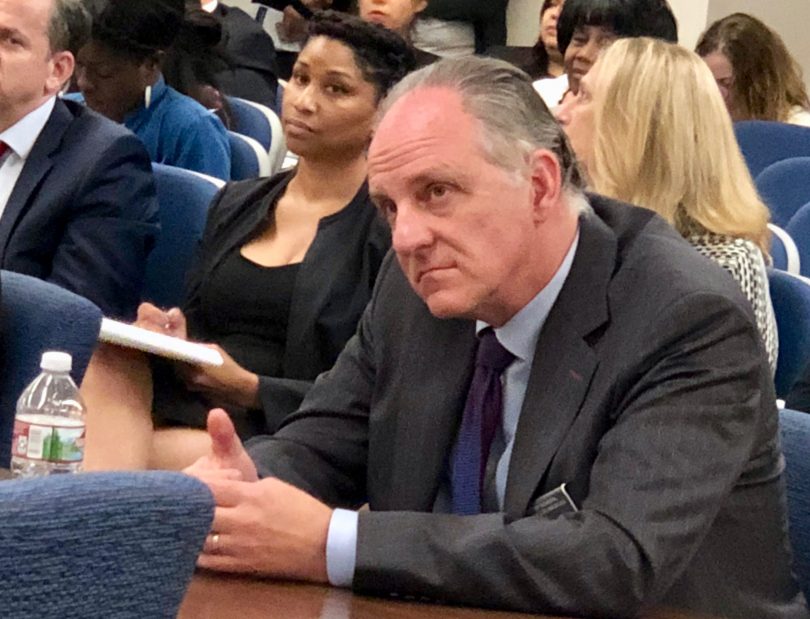

As most readers know by now, Max Huntsman, Los Angeles County’s longtime and highly respected Inspector General has announced his retirement.
His letter to the members of the LA County’s Board of Supervisors (which you can find here) became official last Tuesday, December 9, 2025.
Now that we’re a week past the IG’s announcement, the meaning and importance of Huntsman’s exit from the world of oversight is beginning to unfold in detail.
Sean Kennedy—expert in deputy gangs, professor at Loyola Law School, and founding member of the Sheriff’s Community Oversight Commission, or COC—had this to say when we asked about Huntsman’s retirement:
“Max Huntsman’s resignation letter is an indictment of the entire county government’s approach to oversight of the Sheriff’s Department,” wrote Kennedy in an email to WLA.
“The Board of Supervisors and the County Counsel prioritize secrecy and litigation ‘risk management’ over constitutional policing and procedural justice”
“We will never achieve real police reforms until the Board of Supervisors stops enabling the LASD’s hiding misconduct from oversight authorities.”
When Huntsman and I talked, he described a similar conclusion.
Yet, before we discuss what Huntsman told WLA in recent days, it helps to look at how the job of LA County Inspector General came into being and what that position has to with civilian oversight of the nation’s largest sheriff department. .
The birth of Los Angeles County’s Office of the Inspector General
As longtime WLA readers may remember, the event that directly triggered the creation of the position of Los Angeles County Inspector General, was a lengthy report generated by a temporary advisory group called the Citizens Commission on Jail Violence—or CCJV.
For those unfamiliar, the CCJV came into being in the fall of 2011, with the mandate to investigate the root causes of the ghastly level of violence and corruption that was plaguing the nation’s largest jail system, which is controlled by the Los Angeles County Sheriff’s Department.
At that time, the LASD was led by Sheriff Lee Baca. Yet, in those years—as nearly anyone who was watching was aware—much of the root cause of the violence inside the jails had to do with the fact that department was not in fact controlled by Baca, but by undersheriff Paul Tanaka, aka the shadow sheriff.
Shadow sheriffs notwithstanding, after the seven high profile commissioners that made up the CCJV finished their investigation—which included a series of public hearings, plus the review of thousands of documents—the commission began working on a report in which they would “recommend corrective action as necessary.”
The result was a 194-page report released in September 2012.
Interestingly, among the most urgent among the commissioners’ list of recommendations was the recommendation that LA County must create a new kind of oversight entity: namely the Office of the Inspector General—or OIG.
This Inspector General—wrote the commission—would engage in independent oversight of the department, and report back to “an engaged Board of Supervisors.” Yet the OIG’s oversight would also be independent in order to “ensure that it implements meaningful and lasting reform.”
And so it was that, in November of 2012, two months after the commission’s report was made available to the public, the LA County Board of Supervisors selected Max Huntsman as the best person to have the “responsibility for providing independent oversight” of LA’s troubled sheriff’s department.
“I didn’t really want to work for politicians,” Huntsman told WLA regarding the new job he was offered thirteen years ago.
“I didn’t trust politicians.”
Yet, it turned out that choosing the guy who didn’t want to work for politicians to launch the much needed new oversight entity, may have been exactly the right choice,
Fortunately, while part of him was still reluctant to take the job, Huntsman told us he was heartened by the sense that the board members really “had a reason to want something that they hadn’t wanted in the past,” he said.
“They saw a need for it. And so did I,” he said, meaning the creation of an oversight entity. “And they seemed willing to follow through on setting up something that wasn’t the norm in county government.
“So I took the job.”
The decision paid off when, four years later, in 2016, the same board of supervisors voted into being a second entity to engage in oversight of the LASD. The new entity was christened the Sheriff’s Civilian Oversight Commission, or COC, a 9-member body created to “increase transparency and accountability of the LASD,” by “fostering public trust through recommendations,” monitoring problematic LASD policies, and by working with the Office of the Inspector General (OIG).”
{Editor’s note: For more on the creation of the COC and other relevant information, consider starting this series at Part 1.]
The Alex Villanueva factor
Things got more challenging in 2018, two years after the formation of the COC, when a former LASD lieutenant named Alex Villanueva, defeated then Sheriff Jim McDonald, “which was a terrible thing for the county,” said Huntsman.
“But,” Huntsman added, when we talked, “Villanueva was a great thing for oversight because he did so much outrageous stuff that it triggered additional awareness in the board. This occurred in part “because he went after the board members,” along with a line-up of other people that Villanueva threatened with arrest and prosecution.
Included in the line-up of people then-sheriff Villanueva attacked was LA’s Inspector General Max Huntsman.
(For more on former sheriff Villanueva’s enemies list, check Part 2 of this series, and also take a look at Sean Kennedy’s detailed report describing a “pattern of LASD officials announcing they have opened ‘criminal investigations’ of various department heads, oversight officials, and professionals.” )
(Note: by the time Villanueva was sworn in, both former sheriff Lee Baca, and former undersheriff and Paul Tanaka, were convicted of federal crimes and sentenced to federal prison.)
Subpoena Power
Enemies lists not withstanding, Huntsman told us that, when, in 2018, Villanueva was sworn in to lead the LASD, until he was voted out of office in 2022, by current sheriff Robert Luna, in a weird way, the enemies list-wielding sheriff, “extended the life and effectiveness of this oversight experiment.”
Most notably, as Villanueva’s actions became ever more troubling near the end of July 2019, causing the members of the board of supervisors who were then in office, to make one more important decision to strengthen oversight— which was to make it possible for the COC and the OIG to have subpoena power, which the board saw would be needed if the Inspector General was to be able examine the fifty-year-long problem of deputy cliques in the LA County Sheriff’s Department, among other critical issues.
(For readers unfamilar, the problematic deputy groups were not after work stress-reducing “affinity groups” the members of which played softball on the weekend to lower stress. They are groups with names like the Executioners, the Banditos, and the Grim Reapers, with extravagant tattoos to match.)
To put it another way, said Huntsman, serious oversight would require the right tools.
Earlier, the board rejected the notion of subpoena power, for the COC. That decision changed on Tuesday, July 23, 2019, when Huntsman announced to the supervisors the following:
“I was hired in part to tell you if we ever faced a Tanaka-level crisis again,” he told the board.
“We face it now.” he said, referring to Villanueva.
So, if the county doesn’t want to simply “stand by and watch,” Huntsman said, his expression grim, “we’ll need a stronger ordinance, one that rejects secrecy and has strong mechanisms for enforcement.”
The board, it turned out, did not, in fact, want to stand back and watch.
So the board members—who were a different mix than the present board—elected to make subpoena power happen.
A change in focus?
More recently, however, according to the newly retired IG, what he’d seen in 2019 as a “unified desire” among the present board members to see reform take place. That once unified perspective appears to have “faded” from the county’s leadership, he told WLA.
Now, rather than work toward reform, Huntsman said, county officials appear to focus on the lawsuits that community members continue to bring against the county, resulting in high-ticket settlements.
“The lesson that should be taken from those lawsuits,” said Huntsman, is the fact that the county has a list problems that urgently need fixing,” in order that five or ten years from now,” the county doesn’t have to pay out additional piles of money.
“But that doesn’t seem to be the lesson they learned,’ the retiring IG told us, his tone grim.
“Instead, the lesson seems to be that they must fight the lawsuits aggressively,” rather than fix the conditions that triggered the lawsuits in the first place.
To illustrate his point Huntsman pointed to several examples.
Among those examples he mentioned was the September filing by California’s Attorney General Rob Bonta against LA County, the Los Angeles County Sheriff’s Department, and LA County’s Correctional Health Services (CHS), all of which are responsible for what AG Bonta described the “unconstitutional and inhumane conditions” in the nation’s largest jail system (run by the nation’s largest sheriff’s department).
(See WLA’s story on September’s lawsuit filed by the AG.)
According to Huntsman, the list of troubling lawsuits keeps on coming, and the present board of supervisors, continues to avoid fixing the issues that the lawsuits illuminate.
Huntsman point has been strengthened in the last few days by the LASD’s own reports, which show that, as of today, there have been 45 LA County jail deaths for the year of 2025.
Youth Justice and lawsuits
A similar problem-avoiding attitude appears to apply to the board’s response to the staggering problems that afflict LA County’s youth justice system.
For example, this past summer, when the Board of Supervisors agreed to pay $2.7 million to an 18-year-old young man named Jose Rivas Barillas, who was 16-years old when, in December 2023, with the enthusiastic encouragement of staff, he was beaten by several other young people in the course of a series of so-called gladiator fights that took place at Los Padrinos youth hall in December 2023, a terrifying beating that was captured on CCTV in the facility.
The big payout for the teenager was only made possible because the beating happened to be captured on camera.
WLA reported on the terrible beating, and the settlement. Yet, when, on a whim we reviewed the county’s “Proposed Settlement of Litigation” outline, which contained the county’s lawyers proposed fiscal settlement. It turned out to be an interesting read as it gave a reader a glimpse of the county lawyers’ thinking on the matter, which seemed to be mostly to be self-serving.
“Given the risks and uncertainties of litigation,” wrote the county’s lawyers, a “reasonable settlement at this time will avoid further litigation costs; therefore, a full and final settlement of the case is warranted.”
There was no suggestion that the payout was appropriate, and that there might be a toxic employee culture that produced the beat down, and that this problem needs urgently to be addressed, given that this has to do with young people in the county’s care.
Defunding oversight
County officials just keep making questionable cutbacks, “because they need to make these massive payouts,” said Huntsman.
“So they defund oversight,” Huntsman said, which meant, in the case of the Office of the Inspector General, a 30 percent cut in the OIG’s staff.
“Most of those people they simply took away,”—he told us. “They took them without any consultation, and without any discussion.”
(The COC commissioners work for free, so as do the members of the Probation Oversight Commission, so no one’s trying to slash their membership. Yet the OIG’s staff are not volunteers, thus they need to be paid.)
Now, instead of making use staff of the OIG, with their depth of experience, Huntsman said, the board reportedly plans, instead, to set up a new “ethics office,” which it is hoped will provide strong independent oversight.
In this environment, said Huntsman, it is perhaps not surprising, that in recent months county officials have managed to drive away two of the founding members of the Civilian Oversight Commission (Namely Sean Kennedy, and Rob Bonner.)
“County government always claims to value transparency and accountability,” said Huntsman, “but shooting the messenger,” still appears to be “the most common response to criticism,” he said.
“In my twelve years at this work,” said Huntsman, “I have longed for the day that the county would address the conditions described in our reports without a court fight.”
Oversight & Subpoena power
Theoretically, he said, such legal fights should not be necessary between high profile county employees. But, at the moment, said Huntsman, county officials seem to be ambivalent, at best, regarding oversight of the LA County Sheriff’s Department.
Yet the COC continues—unpaid—the engage in the task of oversite while, in the background, some county officials seem anything but supportive.
Oversight theater
For example, recently civil rights attorney Vincent Miller told us, that the issue of oversight had not been helped by the fact that members of County Counsel—the county’s legal firm that is also the LASD’s legal firm—”had been gunning for Huntsman, more than ever,” right before Huntsman left.
There is, of course, much more to report about the significance of Max Huntsman’s retirement, about the importance community oversight of the LA County Sheriff’s Department, and about the fact that. to do its job, the COC and its lawyer—AKA the Inspector Genera—must be well informed.
With the above in mind, WLA will soon check in with Eric Bates, who has been named by the board of supervisors as the interim LA County Inspector General.
Five Steps forward & four and a half back.
Also, as WLA was finishing this story, I noted that on the agenda for the upcoming COC meeting, there was a note suggesting that the COC might do away with a longtime ad hoc committee on the topic of deputy gangs,—an problematic issue long examined by the COC and that, with rare exceptions, is unique to the Los Angeles County Sheriff’s Department.
Furthermore, as it happens, when it comes to the topic of deputy gangs, it would be difficult to find anyone more expert in the UC than former COC member Sean Kennedy.
Kennedy told me that this shouldn’t be a big deal that he would attend the meeting to explain the essential nature of keeping alive the ad hoc committee on the corrosive issue of deputy gangs.
In the meantime, some progress was made this year in the realm of LASD oversight when, in October, Gov. Gavin Newsom signed a bill into law known as AB 847, which granted civilian oversight bodies across California the ability to view confidential law enforcement records in private sessions.
Some are concerned that new law may not go far enough. But most consider it a cheering beginning.
Bad news good news
Concerns had already been raised this past June, when the Office of the County Counsel announced it was investigating COC founder, Sean Kennedy, for alleged retaliation against a sergeant who was among the handful of department members (or former department members) that former sheriff Alex Villanueva reportedly hand picked for the LASD’s then newly formed “Civil Rights and Public Integrity Detail,” a unit whose members were reportedly tasked with pursuing possible of criminal cases, against those on Villanueva’s alleged enemies list. (For details, see Part 2 of the series.)
With the above issue in mind, in mid-september of 2022, the Civilian Oversight Commission held a series of public hearings to question deputies and others with knowledge of deputy gangs, along with those department members who were reportedly placed on a secretive unit within the L.A. County Sheriff’s Department accused of targeting the foes of former Sheriff Alex Villanueva.
The hearings were conducted by an expert attorney from outside the COC, reportedly to avoid any kind conflict of interest.
Teran acquitted
In other news, this past June, the case of Diana Teran, was dismissed by a three-judge panel, who explained their unanimous decision in an unusually well-written ruling.
In the ruling, Associate Justice Carl H. Moor wrote that AG Bonta misused a statute that is meant only to criminalize the hacking of, or tampering with, computers and data, and used the obscure statute to charge Diana Teran for sharing publicly available court filings with her colleagues at the LA districts attorney’s office.
“The legislature never intended this statute — which is principally aimed at computer hacking and tampering — to be used to criminally prosecute disclosure of purely public information that happened to be stored on a computer,” wrote Associate Justice Moor.
“These court documents convey nothing,” Moor added, “that a member of the public could not learn by sitting in a courtroom attending the court proceedings or reviewing publicly available information from the court’s docket and files….”
There’s much more to the opinion, but you get the idea.
And… in additional news…next November, among other elections, LA County voters will be asked to decide if they want to keep Sheriff Robert Luna for another term, or if they would they prefer to exchange him for one of the growing list of challengers, a list that includes Alex Villanueva, who announced his candidacy in July of this year.
And life goes on
In the interim, the unpaid members of the LA County Sheriff’s Civilian Oversite Commission —or COC—continue to meet, month-in and month-out. At those approximately four-hour meetings, a good-sized cluster of community members show up —either in person, or virtually.
Those who attend appear to live in a wide variety of communities, and they generally attend the meetings in order to tell the commissioners of their lived experience—bad or good, or very bad, or very good—with the approximately 10,000 sworn deputies of the LASD who are tasked with protecting and serving those who live in Los Angeles County’s 141 unincorporated communities, or in one the 42 “contract cities,” that the nation’s largest sheriff’s department also serves.
More as we know it. So…stay tuned.
He does nothing has no authority
The defund the police movement is truly dead. A dead orphan, no politician will touch it with a ten foot pole, much less admit they ever had anything to do with it. This is the reality the board of supervisors find themselves in. Do they support the current Sheriff (the guy they wanted) and keep the Sheriffs department intact? Or do they continue to fund the law professors and Ivy League lawyers whose jobs rely on finding novel ways to dismantle the same Department?
The board has made the only logical decision it could, the Huntsman, Bobb, Kennedy, Tran types offer nothing but an endless drain on the county while providing nothing real in return. The Sheriffs Department isn’t perfect but it does provide policing and after all that’s what the public wants.
What him get a settlement for a civil claim like the rest of them. It’s the way to payoff people to not snitch on the political dirty deeds.
This was all a predictable shame. Max is a decent guy with a strong background in prosecuting governmental misconduct and corruption. The seeds and spawn of Paul Tanaka is a cancerous tumor that will infect LASD for twenty years. Max turned over a few rocks and exposed a portion of the vermin inside LASD and the BOS suddenly decided they didn’t like what they were being told. So, slay the messenger, Max. If the BOS thought for a second they could guide and control Max to do their bidding, they found out how wrong they were. There is rot inside LASD, Max just started to identify it, slay the messenger. And in the end, the BOS won, they got everything they wanted, complete control. Villanueva surrounded himself with fools, they were mostly all children of Tanaka. Alex was given a gift yet because of poor council, listening to fools, he shot himself in the foot so many times, he could no longer walk. The BOS found a way to throw him out like Sunday’s trash. The BOS found, supported and installed a lapdog Sheriff who will do everything he’s told, and he does. County Council has one client, the BOS, they write the checks, they do as they are told. After all, the BOS is their client. Max wanted answers, the BOS didn’t. “Make it go away, write the checks, don’t expose anything.” This became a political charade of “cover our ass and Max, please sit down and shut up.” Wrong guy. And in the end, Max and some of his folks are gone, LASD is an absolute disaster, the Sheriff does everything he’s told to do, the local news media reports nothing because they too are lap dogs of the BOS and…….nothing changes. The smiling faces of LASD, BOS and LA County government are there with platitudes and smiles, “Okay folks, move along, nothing to see here.” And the voters don’t care, they are programmed to “re-elect” all of them. Good luck Max, you tried, you really did. But “they” were never going to allow you to do your job. You and your crew were just window dressing until the smoke cleared. Without true journalism, there is no sunlight of truth. Wonder what the new guy will do?
As much as I was glad to see the McBuckles era to end, Alex turned out to be a despot. Like a return to the Baca-Tanaka era. Now Luna is the BOS lapdog and the darling of the defund crowd.
We need someone like the SBCS. Discus seems to know how to support his deputies. And not battle with his BOS
Block. Pitchess, Biscailuz. They seemed to figure it out.
Not keeping the sheriff an elected position would be a big mistake.