Thursday, May 17, 2012
street news, views and stories of justice and injustice
Follow me on Twitter

Search WitnessLA:

Recent Posts

Categories

Archives

Meta

LA city government


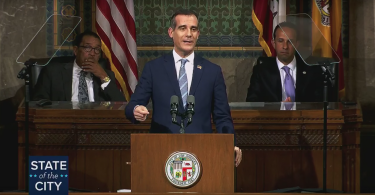
Villaraigosa’s State of the City Speech Gambles on Education Reform

April 14th, 2011 by Celeste Fremon


On Wednesday at approximately 5 p.m. Mayor Antonio Villaraigosa
gave his sixth state of the city speech. As anticipated, although AV talked about topics like the potential greening of LA, about the crime drop, and about filling more potholes, the speech’s centerpiece was about education reform, the one topic out of the list over which the mayor has exactly zip direct control.

Some of the potential candidates who hope to take his place after Villaraigosa terms out, tisk-tisked to LA times reporters about how AV should have instead addressed the city’s fiscal deficit, in that forming a workable city budget is a part of the LA mayor’s actual job description.

The critics made a fair point.…and yet….and yet…

In truth, Antonio did precisely the right thing with his speech. If we are to bounce back as a city and as a state nothing, and from there begin once again to thrive, nothing could possibly be more important than building on the fragile areas of growth and reform in the district, and blasting out of the road the calcified and obstructionist attitudes that have been so wrong-headed and ruinous to our schools and our kids for such a very long time.

Villaraigosa delivered the speech at Thomas Jefferson High, a school that six years ago—right after AV was first elected mayor—erupted in a series of huge and traumatizing riots on campus.

I was assigned to cover Jefferson’s riots for the LA Weekly, and so spent a lot of time at the school during the jittery days and weeks that followed.

In particular, I spent dozens of hours talking to teachers, administrators, kids, school police, parents, and others—all of whom were surprisingly eager to spill what they knew to somebody, anybody. They talked, not so much about the riots, but about a school that had a 31 percent graduation rate, where only 9% of Jeff’s students tested “proficient” in English, just over 1 % were proficient in math, and about the conditions on campus and at the district that made teaching and learning at Jefferson a discouraging daily swim upstream against an overwhelmingly strong current.

Worse, Jeff was merely one of many LAUSD high schools that had similarly ghastly stats and conditions.

It soon became evident that the so-called riots were not the story at all, but a big, bad signpost that pointed to the real story—which was the catastrophic state of LA County’s education system. The riots were the canary in the coal mine.

Yet, as bad as things were, at a district level, those in charge seemed too paralyzed to make any substantive changes. Instead they would hire a one more string of very high priced independent consultants, who delivered high priced reports that generally came to nothing.

Six years later, as Antonio points out, some heartening progress has been made in some pockets. But not anywhere close to enough progress.

Villaraigosa clearly hopes to shove the reform efforts into high gear before his mayoral term is up.

“This is a pivotal moment for our schools and our City,” the mayor said, and reminded the those assembled that we have a new superintendent of schools, John Deasy, whom he likened to “Bill Bratton with a ruler,” and newly elected union leadership that appears to want to turn over some kind of new leaf.

Then Villaraigosa got down to specifics about the changes he sees as essential.

JIn her dead-on column about the speech for the LA Weekly, Jill Stewart laid out the heart of AV’s message:

He called for turning LAUSD into a network of local, independently controlled campuses, allowing “open enrollment beyond traditional neighborhood boundaries” to create parental choice, and for “protecting and expanding the use of the parent trigger” to give parents the power to convert failing schools.

Finally, he issued the hottest news:

“The teacher contract expires in June,” Villaraigosa said. “With the stars aligned, we have to seize the opportunity. Let’s (devise) a new contract … Let’s stop dictating at the district level and let local schools make the decisions” on such things as staffing, funding and curriculum.

“Let’s compensate teachers for demonstrated effectiveness — not just [for their] years of service and course credits …. and do away with the last-hired, first-fired seniority system.”

He said to loud applause: “When more than 99% of district teachers receive the same ’satisfactory’ evaluation, it serves nobody.”

Finally, he added: “I know that these proposals will raise some concern and spark controversy. I could hear some of the people [protesting] outside. As a former union organizer, I understand your fear. I stood with you then, and I’ll stand with you now. Change is hard.”

But he added: “Our time is now. The nation is watching. L.A. must take the lead.”

(Read the rest of Stewart’s column. It’s a good one—so far about the best thing I’ve read on the speech.)

“We’ve had our differences with the mayor…” said the LA Times said in its own editorial on Villaraigosa’s SOC speech.

Yes, well, haven’t we all.

But this time Antonio was right on the mark.

“We can fulfill the promise of public education by agreeing to a new contract with ourselves—a promise to put aside the concerns of a few adults in the interest of all children,” he said.

And he sounded like he meant it.

Here’s the full text of the speech.


Photo by Gary Friedman for the Los Angeles Times

Posted in Education, LA city government, LAUSD, Mayor Villaraigosa | 6 Comments »

Homegirl Cafe Coming to LAX

September 21st, 2010 by Celeste Fremon


Although prospects had looked bleak for months, when four out of five of LAX’s wildly lucrative
food and beverage contracts were finally handed out on Monday afternoon— an unexpected beneficiary of the decision is Homeboy Industries’ popular and unique Homegirl Cafe.

In a decision that seems to have been complicated by more than the usual number of lobbyists, personal agendas, and multiple conflicts of interest (see stories byDavid Zahniser and Gene Maddaus for some of those specifics), the special five-person LA City Council panel known as the Board of Referred Powers decided (in a 4-1 vote) to award four of the five of LAX’s wildly lucrative food and beverage contracts and, at the same time, to throw out the bid by the celebrity-packed group that was originally the front-runner in the contract contest.

The fifth contract will likely be rebid in the near future and it is hoped that the whole five contract food and beverage package. (plus three additional airport vendor contracts) will be up for approval by the full city council in about a month.

(For some of the finer details on the contract squabbles, and the tortured road to Monday’s contract awards see the LA Times story, the Daily Breeze coverage, and the article in the LA WAVE.)


The Homegirl Cafe—one of Homeboy’s six businesses— is among the vendors included in the bid put forth by Miami-based Areas USA, which was originally figured to be a dark horse. When Areas USA was selected, that meant that Homegirl Cafe was too—along with other food purveyors like downtown Los Angeles steakhouse Engine Co. 28 and Culver City-based gastropub Ford’s Filling Station.

Although it is known for the fact that it trains and employs young women recovering from gang life and/or incarceration, Homegirl Cafe is also an excellent and uniquely LA food purveyor in its own right. (Homegirl describes its fare as “Latina flavors with a contemporary twist.” ) Its fully organic menu features delicate-flavored dishes designed by Chef Patricia Zarate using vegetables and herbs from its own organic garden and other local farms.

Father Greg Boyle was also among those who spoke to the panel at the meeting that concluded late Monday afternoon. When I saw him later on Monday night (at an unrelated gathering), he was extremely pleased, as would be expected, but still seemed a bit stunned by what, for Homeboy, is a very happy turn of events—yet well deserved in terms of the quality of the cafe itself.


The fifth and final contract was not awarded Monday after a winning bid involving some of LA’s best known chefs (Nancy Silverton, Susan Feniger and Mary Sue Milliken) was unexpectedly tossed out because of a possible conflict of interest that the LA city attorney’s office believed might trigger a court challenge and thus fatally delay the entire LAX project.

A clearly disappointed Silverton also spoke at the Monday’s meeting. “I want to warn you, If you don’t you’ll help us, the people of L.A. and the visitors to L.A. may be stuck with food choices and food quality that are currently available to them at every off-ramp on every freeway across America.”

(Well, not exactly. Nancy, we love you but you aren’t the only food game in town. Sorry.)

The group that includes Silverton et al, plus Boyle Heights’ la Serenata De Garibaldi and the local favorite Bertha’s Soul Food, is expected to rebid for the final contract.

(Wouldn’t it be nice if we could have Homegirl and some of our LA star chefs, La Serenata and Bertha’s Soul Food? )

In the meantime, it feels great to cheer Homegirl’s well-earned victory.

Posted in Homeboy Industries, LA City Council, LA city government | 5 Comments »

Follow the Gang Money, Part 2: The Interventionists – by Matt Fleischer

September 8th, 2010 by Celeste Fremon

EDITOR’S NOTE: With 1,076 known gangs and 80,757 gang members in Los Angeles County (according to the LA Sheriff’s Department) LA is still the gang capital of the nation. To address the gang violence problem that has tens of thousands of our city’s children reporting that they are scared on their walk to school, Los Angeles has budgeted $26 million.

So, is our city using that pot of taxpayer dollars well and wisely? Are the programs it buys making our violence-haunted communities safer? Are they effective in helping kids-on-the-edge stay out of gangs? Do they offer tools and alternatives to those desperately seeking a route out of gang life?

These are some of the questions we asked with our two-part investigation: Follow the Gang Money, reported and written by Matt Fleischer (and copy edited by Craig Gaines).

Follow the Gang Money is the first effort to come out of the LA Justice Report, which was created through a partnership between WLA and Spot.Us.

In the course of his investigation, reporter Matt Fleischer found bright spots, to be sure. But he also found a city gang program mired in secrecy, plagued by bureaucratic bungling, and lacking in the kind of accountability that was repeatedly promised when all of LA’s gang dollars were transferred from the city council to the mayor’s office.

In Part 1, Matt looked at the city’s flawed gang prevention program and why it was systematically excluding many of LA’s kids who most needed its services.

Now he looks at the rest of the story with his exploration of the city’s gang intervention program.

In doing so, he finds a whole new set of bureaucratic screw ups that resulted in even more wasted evaluation money than the City Controller originally reported.

Even more troubling, he finds that the strategy in which the city has invested most of its intervention $$—touted as the model for the nation—is in fact a copy of a much criticized program that has been shown in multiple studies to be ineffective at best and, when replicated in one city, actually harmful.

You’ll find the details and more in Part 2 of Follow the Gang Money.


PART TWO: THE INTERVENTIONISTS

Is the city pouring its gang dollars into a strategy that won’t work?

by Matthew Fleischer

Jose Leon remembers the first time he saw a shootout in the streets of his Boyle Heights neighborhood. “I was 5 years old and staying at my uncle’s place. I looked out the window and saw this guy running down the middle of the street, shooting. I got scared.”

A squat, powerful man with a shaved head, tattoos peeking out of his sleeves and eyes that read much older than his 21 years, Jose’s life in Boyle Heights got, if anything, more traumatic as the years passed until it read like a blueprint for gang membership by the time he was an adolescent.

“I had aunts and uncles who used to slang [sell drugs]. They were from the old neighborhood—Soto Street.”

As Jose got older, the shootings in his neighborhood became a routine part of his day, and fear of street life turned to fascination. He joined a tagging crew when he was 11 and joined a full-fledged street gang shortly thereafter. He was stabbed at age 14 when a rival crew ambushed him at Roosevelt High School.

“I got stuck in the stomach,” he says. “Spent a few days in the hospital.”

When Jose graduated from Roosevelt in 2006, he thought about getting out of gang life. But he was unsure how to replace the camaraderie and the income, frankly, that the gang world provided. He tried to find a job, but with no luck: By that time, Jose had a criminal record and no one wanted to take the risk in hiring him.

So he continued to sell drugs to get by when things were lean.

Then, two years ago, Jose saw a road out when he began working with Johnny Godines, a local gang intervention worker with the East LA nonprofit Soledad Enrichment Action (SEA). Jose had met Godines back in high school. He was an old-timer who had turned his life around and was now helping kids in the schools and on the streets. Godines knew the game, knew all Jose was going through, and had kept an eye out for him. But more importantly, he was a friend and mentor who constantly reminded Jose there were better things in life than what gangs had to offer.

“Johnny and me had some really good conversations. He said things that made me start thinking about me.”

Nearly eight months ago, thanks to his relationship with Godines, Jose landed a job in SEA’s human resources department. Now he works 8:30 to 5 to support his infant son and says he has no desire to return to gang life. By all accounts, Jose’s is a true gang-intervention success story—the kind that the city would seemingly want to see replicated with other troubled youth across the city.

But even though SEA is the largest organization within the Gang Reduction and Youth Development network (it runs one-third of the GRYD’s 12 neighborhood zones) stories like Jose’s are rare within the city-run program. Therapy, education, tattoo removal, and especially job training and placement—the kinds of things that are essential in helping gang members to leave the life for good—are not the priorities of the roughly $7 million intervention side of the $26 million program. (GRYD also has a prevention component [see Part 1 of this series].) Instead, the city’s intervention focus is on something called “proactive peacemaking,” otherwise known as hardcore street intervention.

GRYD’s intervention model is based on Chicago’s “CeaseFire” program, and it works like this: Local men and women–often former gang members who still have clout on the streets–are assigned to the GRYD neighborhood zone they are most familiar with, and instructed to sniff out threats of retributive violence between gang members and to try to broker truces between rival gangs. Intervention workers serve as both liaisons between gangs—a reliable means of transmitting messages between rivals—and sources of street expertise for the Los Angeles Police Department, with whom they have weekly meetings to discuss hotspots and crime trends and are supposed to contact if a violent showdown seems imminent.

GRYD has codified this method of intervention by investing $200,000 per year in the Los Angeles Violence Intervention Training Academy (LAVITA), which is attempting to train and professionalize street intervention workers and standardize their approach in the field.

“Our mission is not to break up a gang,” says Susan Lee, the Advancement Project’s director of urban peace, who oversees LAVITA. “Our mission is to reduce violence. We are about peacemaking.”

Advancement Project co-director and civil rights attorney Connie Rice explains the mission in more detail: “Hardcore police suppression has not reduced gang influence in our city. Gangs saturate the physical spaces of our neighborhoods: parks, schools, hospitals. We’ve let this problem get to the point where we need people with the street credibility to negotiate with gangs. Police can’t do it. Academics can’t do it. Politicians can’t do it. I can’t do it. These guys can.”

LAPD agrees, and though initially skeptical of street interventionists, they have come around to viewing these men and women as a useful component of violence reduction. “Without question we call on these guys,” says Northeast LAPD Captain Bill Murphy. “It’s my experience they know what’s going on and they provide options for how to deal with various situations. You can’t just arrest your way out of a problem.”

But while the idea of training former gang members to roam their old stomping grounds and talk their homies into forgoing violence has an undeniable narrative sexiness, and the backing of the LAPD, it’s an open question whether this strategy actually has a measurable impact. There is much evidence to suggest that, absent other services and active community involvement, “proactive peacemaking” produces no long-term effect, and in certain instances can even make things worse. In a 2010 RAND study of Pittsburgh’s GRYD-like street intervention program, RAND researcher Jeremy Wilson theorizes “that the presence of outreach workers increased the cohesion of gangs, making some groups more organized, in turn leading to increased violence.”

The real $26 million question facing Los Angeles is why are we basing a gang-reduction strategy on a model that has no proven long-term results?


WHAT DOES IT TAKE TO CHANGE A LIFE?

On a hot, muggy day in mid-May, Father Greg Boyle enters the front door of Homeboy Industries in downtown Los Angeles to find several hundred current and former gang members staring him in the face.

“Happy birthday,” the entire room yells in unison before launching into song—once in English and once in Spanish.

Boyle professes surprise, but the secret birthday party has become an annual rite of spring at Homeboy Industries, America’s largest gang-intervention program. Boyle’s efforts have helped thousands of kids escape gang life and have earned him a national reputation. This year, however, while cake is passed around and conversation flows, there’s somber reality lying just beneath the surface of the celebratory mood. Virtually all of its more than 427 employees have just been laid off, and the future of the program is in serious doubt. News of Homeboy’s financial troubles have gone national—yet the program is nowhere near to raising the $5 million it needs to continue to run its programs. Its fate, and the fate of all those celebrating, is a giant question mark.

The potential catastrophic cuts in Homeboy’s services come at an especially crucial time since, with unemployment still in double digits, former gang members needing jobs are coming to them for help in greater numbers than ever. Homeboy, as well as organizations like the Toberman Neighborhood Center in San Pedro, practice a different type of intervention from the city’s Gang Reduction and Youth Development network—a services-based model that focuses on turning gang members into productive members of society instead of the tourniquet approach of asking gang members not to shoot at each other.

“We don’t deal with gangs, we deal with gang members,” says Boyle.

The logic behind the approach is similar to the CIA’s refusal to negotiate with terrorist organizations—although Boyle certainly wouldn’t put it in those terms. Instead of dealing with the gangs themselves, Homeboy serves gang members, plus men and women freshly out of prison and on parole, who want to turn their lives around. There are tens of thousands in each category, 12,000 of whom walk through the doors of Homeboy Industries every year looking to reinvent their lives.

Homeboy Industries offers various types of job training and placement programs. Its solar panel installation training program in partnership with East L.A. Skills Center has a long waiting list. Homeboy also has its own businesses, which employ 150 to 200 former gang members: Homeboy Bakery, Homeboy Silkscreen and Embroidery, Homeboy Merchandise, Homeboy Maintenance and the Homegirl Café. In addition, the program offers tattoo removal, GED prep, computer training, substance abuse counseling, legal advice, reentry services for parolees and juvenile probationers, comprehensive mental health and family counseling.

In other words, Homeboy Industries offers the basic services that a gang member most needs to send his or her life in a productive direction.

Boyle admits he is not a big fan of the hardcore street intervention method. Before developing Homeboy, Boyle says he practiced street intervention for nearly a decade, brokering truces, racing late at night between warring gangs to calm violent situations, chasing down individual kids who he knew were at risk of shooting. But by the mid-1990s he concluded that it was not an effective strategy. He also says sending in former gang members to do street intervention keeps them bound to the gang milieu.

“You wouldn’t send a recovering alcoholic into a bar to recruit for AA,” says Boyle. “It’s the same principle here. People have to want to leave this life behind.”

But is there evidence that the services-based model works any better?

As it turns out, there is. Homeboy Industries reports a 70 percent retention rate, which is quite high given that 30 percent is considered good among program evaluators. (Alcoholics Anonymous has a 10 percent retention rate.)“And out of the 30 percent who drop out [of the Homeboy programs],” says Mona Hobson, Homeboy’s director of development, 10 percent to 15 percent return “when they’re ready to embrace the program.”

Homeboy’s individual programs show similarly upbeat results. For instance, Liz Miller of the University of California, Davis, studied 502 clients of Homeboy’s Mental Health Education and Treatment Assistance Service, and found a dive in “depressive symptoms” from 64 percent to 26 percent during a three-month period.

Now Homeboy is being evaluated even more rigorously. UCLA researchers are two years into a five-year longitudinal study of the program’s effectiveness. The research regarding Homeboy’s success in transforming its clients’ mental and behavioral health isn’t final, but lead researcher Jorja Leap, an adjunct associate professor at UCLA’s Department of Social Welfare, says: “Homeboy is off the chart at stemming the tide of reincarceration. Simply in terms of cost effectiveness, services at Homeboy cost about $40,000 per person per year. It costs upward of $120,000 a year to put a person through the criminal justice system. And the preliminary evaluation outcomes [at Homeboy] are remarkable.”

Homeboy isn’t the only model in Los Angeles that has shown proven results. Leap also spent two years evaluating the Professional Community Intervention Training Institute (PCITI), run by longtime interventionist Aquil Basheer, who’s been doing this type of work since 1969, and found promising results. Basheer’s training methods yielded a 95 percent retention rate.

Interestingly, unlike Homeboy, Basheer’s model incorporates hardcore street intervention into its services-based approach. “I applaud the city and anyone out there trying to save lives,” says Basheer. “But if gang intervention is an octopus, hardcore street intervention is just one tentacle.”

Read the rest of this entry »

Posted in Gangs, LA city government, LAPD, Mayor Villaraigosa, THE LA JUSTICE REPORT | 21 Comments »

FOLLOW THE GANG MONEY: Part 1 – by Matthew Fleischer

August 16th, 2010 by Celeste Fremon

EDITOR’S NOTE: The article below is Part One of WitnessLA’s two-part investigation into how the city of Los Angeles spends its $26 million per year in gang violence reduction dollars.

This investigation was reported and written by Matt Fleischer (and copy edited by Craig Gaines). It is the first effort to come out of the LA Justice Report, which was created through a partnership between WLA and Spot.Us.

You’ll find that both sections of this series are quite critical of multiple aspects the gang programs that have operated under the umbrella of the mayor’s office for the past two years—and with good reason. We went to great lengths to get documents and information that the mayor’s people made clear they did not want us to have. Much of what Matt found at the conclusion of his digging and reporting is, we believe, cause for concern–and rigorous rethinking.

However, just to be clear: our criticism does not suggest for a minute that the $26 million in gang dollars is not worth spending. All that money and more is needed to address the fact that hundreds of thousands of LA kids feel unsafe walking to school because of gang violence. But it is essential—particularly in these budget strapped times—that those much-needed funds are spent in ways that are measurably effective in addressing the problems for which they were allocated.

To that end, we give you Part One of Follow the Gang Money. We’ll have Part Two in a couple of weeks.

Then in September, we’ll have a wrap-up that looks at where we go from here.


FOLLOW THE GANG MONEY: PART ONE:

Are LA’s Gang Prevention Strategies Excluding the Kids Who Most Need Our Help?
by Matthew Fleischer


On a hot day in early May, nearly 200 gang-reduction experts
under the umbrella of the city of Los Angeles’ Gang Reduction and Youth Development program, or GRYD, gathered in the LA City Council chambers to fight for their jobs. There were too many intervention workers, some of them former gang members with extravagant tattoos and shaved heads, to cram into the rows of seats in the City Council chambers, so they spilled into the hallways instead, greeting each other fondly and chatting nervously about their fates. With the city facing a $212 million budget shortfall, the City Council was looking to do some serious fiscal trimming, and GRYD’s $26 million in operating funds were slated for the shears.

As the council meeting came to order and the public comment period began, these men and women stepped to the microphone at the center front of the chambers and told stories of bullets whizzing, children dying and the great risks they took in their daily lives to keep their communities safe. In between their testimonies, a sprinkling of tweedy academic types from the administrative ranks of these same gang-reduction programs came forward to bolster the street workers’ pleas with facts and figures.

No money should be slashed from GRYD, each of them said, in one impassioned way or another. Despite its budget woes, this is one program cut Los Angeles cannot afford.

“We’re saving lives,” was the common refrain.

Last to speak, and most eloquent, was civil rights attorney and gang intervention expert Connie Rice, whose 2007 Advancement Project report, “A Call to Action,” was part of what triggered the formation of GRYD in the first place. More recently, Rice and her Advancement Project have been tapped to run the city’s Los Angeles Violence Intervention Training Academy (LAVITA)—which is attempting to train and professionalize gang intervention workers. “We are celebrating low crime, but in the hot zones, kids still dodge bullets,” said Rice. “These [gang workers] are the people who keep the kids safe. The GRYD office is absolutely essential. We just spent $7 million for a reptile enclosure. I’m happy for Reggie [the alligator], but we need to save our kids first.”

Although some of the city council members fully intended to snip GRYD’s funds, Rice made her pitch with the knowledge that the program enjoys the unequivocal backing of LA Mayor Antonio Villaraigosa. Ever since his school reform efforts sputtered and stalled, Villaraigosa has taken to GRYD as his new flagship policy effort. He routinely touts it as “among the most innovative in the U.S.,” and has the habit of making lofty claims about GRYD’s impact: “The program has reclaimed our city for our citizens.”

Within days of the City Council hearing, the mayor, Connie Rice and the rest of the GRYD network got their way: GRYD would receive full funding for another year, which in 2009-10 amounted to $26 million, $18.5 million of which came directly from LA’s general fund. In the following weeks, virtually every other program in the city would be cut amid LA’s budget crunch—the library system, city attorney’s office and even the LAPD’s counterterrorism task force among them. GRYD was among the few allowed to remain intact.

It was a major political victory for Villaraigosa and Gang Reduction and Youth Development.

The mayor reacted to the news with a celebratory tweet: “Our GRYD programs WORK—gang crime is way down and more kids have a way out of the gang life.”

A two-month investigation by the LA Justice Report, however, has revealed that the mayor and the City Council’s confidence in GRYD’s central programs isn’t grounded in quantifiable facts. In truth, no one knows if, how well or how poorly GRYD is working—not the mayor, not the police, not GRYD itself.

Power and accountability have been consolidated in the mayor’s office, but there is still no way of determining whether the program is effective. And there are many indications that methodological errors have been made that have cost—and continue to cost—the city millions of dollars.

A recent audit by LA City Controller Wendy Greuel stated that, after nearly two years, GRYD, much like LA Bridges, still has no adequate evaluation of its effectiveness, or lack thereof—despite the city’s spending $525,000 (with another $375,000 soon to be paid out) for an assessment report from the Urban Institute (UI).

“We had years of a feel-good program under LA Bridges,” Greuel says. “Now we’ve spent more than $500,000 on a tool to see what’s working, but we still don’t have that yet.

“Transparency is the biggest problem we face.”

But while Greuel placed most of the blame on the irritatingly secretive assessment conducted by the UI, the Justice Report found the real failings to be not with the UI researchers’ evaluation of the GRYD programs, but with the programs themselves. Though it took weeks and multiple California Public Records Act requests, we acquired a copy of the UI’s 60-page evaluation and found it most revealing. After speaking with the UI head evaluator and two independent evaluation experts, we have learned that UI had a perfectly acceptable methodology in place. GRYD, however, has been hampered by serious bureaucratic blunders, prime among them poorly negotiated contracts that resulted in the loss of a year of data.

But beyond pure evaluation and data-collection screw-ups—of which there have been plenty—the Justice Report discovered gang prevention programs that may be systematically excluding many of the kids that most need their help and intervention programs that are based on a model that has little or no proven success. Further, the programs may fail to emphasize the most basic services that have been shown to help the men and women in LA’s most violent, troubled neighborhoods leave gang life behind.

As with many city and county problems, the situation is complex, so bear with us. Policy analysis can be wonky at times. But this is no academic exercise. LA is the gang capital of America, and the stakes of the gang-reduction debate are measured in blood.


Read the rest of this entry »

Posted in Antonio Villaraigosa, Gangs, LA City Council, LA city government, THE LA JUSTICE REPORT | 12 Comments »

Follow the Gang Money: The Controller’s Report

July 27th, 2010 by Celeste Fremon


On Tuesday, City Controller Wendy Greuel released her audit
of the effectiveness of the city’s Gang Reduction and Youth Development programs—aka GRYD. (The report follows-up on former Controller Laura Chick’s 2008 report.)

Overall Ms. Greuel said that the programs had made a lot of progress and, in effect, laid down a promising foundation on which future progress may be built.

Her main criticism was that the city had spent $525,000 on an evaluation of the programs (with the cost of the ongoing eval rising as I type), but had gotten no real evaluation for that half million bucks plus.

As you will see when we begin our Follow-the-Gang-Money stories, we agree completely with Controller Gruel about the not getting much for the evaluation $$$.

But we have found that the problem goes a bit deeper. We have read the Urban Institute’s 60-page evaluation report very carefully.

And, yes, surely the controller is right: It is beyond maddening to find that, nearly 2-years in, we have no practical assessment of the city’s gang programs—particularly after all the promises made that, once the gang money was moved under the mayor’s umbrella, Priority One would be the twinned values of transparency and accountability.

However after a very thorough examination, we have found that the larger problem is not with the Urban Institute evaluators, who seem quite competent and professional. It is with the programs. The Urban Institute delivered a 60-page, $525 million NON-evaluation because—-there is not a whole lot to evaluate.

Details to come soon.

So stay tuned.


(NOTE: I’m still ensconced in a cabin on river in West Glacier, Montana, with a (gasp) dial up connection to the Web. This means the 24-hour-news cycle has slowed down to something like 72 hours. But, Matt Fleischer and I are on top of this gang money issue—among others. And there will be a lot of new stuff when I return—and likely sooner.)


Here’s the LA Times’ report on the Report.


NOTE # 2: The photo isn’t of the river in back of our house, but of nearby Lake McDonald.

Posted in Gangs, LA city government | 21 Comments »

The 1st LA Justice Report is Funded: Story Coming in August

July 15th, 2010 by Celeste Fremon


Thanks to 88 fantastic people,
the first LA Justice Report story is fully funded.

(Woooo-hooo!)

This is a very, very good thing—particularly because reporter Matt Fleischer has been hard at work on the story for over a month.

The LA Justice Report, as you may or may not remember, is a partnership between WitnessLA and Spot.Us. It uses the Spot.Us wonderfully cool “crowd-funding” model to support social justice-oriented investigative journalism in LA.

The partnership’s first project is called Follow the Gang money, and it will look at how the city of Los Angeles is spending it’s $26 million of gang violence reduction money, which is dedicated to gang prevention and intervention. That $26 million is one of the very few city budgets that was not cut this past budget slashing season.

Matt has done incredible reporting, in several cases employing the excellent tool known as the Public Records Act to get the information that the mayor’s office and others were a bit…um…slow…to fork over.

Now, we have the answers.

Matt’s resulting story series will be published here in the 3rd week of August—(In other words, a few days after WLA and I are back from vacation).

What Matt has learned will, I promise, surprise, interest and likely infuriate you.

But here’s the thing: Los Angeles is our city, and we have the right to know how our money is spent on such essential issues. If the information is withheld, we have the duty to acquire it.

So we have done just that.

Thank you to all of you who have thus far been a part of our collective endeavor.

And for those of you who have not donated or acquired credits to donate: don’t worry, there will be other opportunities ahead. Trust me.

In the meantime, stay tuned. An important LA story awaits you.

Posted in Gangs, LA city government, THE LA JUSTICE REPORT | No Comments »

County Sups: $400K Death Payout, City Council: Vote on Trutanich Grand Jury

June 29th, 2010 by Celeste Fremon


TRUTANICH’S GRAND JURY

Tuesday the City Council is tentatively scheduled to discuss SB 1168, the bill that would allow City Attorney Carmen Trutanich to have his own grand jury. The bill has passed the state senate and with a trip to the state assembly still ahead.

The City Council will decide whether or not it is in favor of the bill. Councilmembers Jan Perry and Bernard Parks are strongly opposed, and would like the idea to be put to a vote of the residents of Los Angeles.


COUNTY SUPERVISORS EXPECTED TO VOTE $400,000 TO SETTLE JUVENILE HALL MEDICAL NEGLIGENCE/WRONGFUL DEATH LAWSUIT

Also on Tuesday, the LA County Supervisors are scheduled to vote to settle a lawsuit brought by the parents of Tremayne Cole.

The bare bones of the case, which is expected to be settled for $400,000, are as follows:

According to the county’s own report, on February 5, 2008, a short, skinny, 14-year-old boy named Tremayne Cole was placed in one of LA County’s juvenile halls, Los Padrinos. Four days later, on February 9, Tremayne complained of a bad headache, a tooth ache, and he was running a fever. Although he was given medication, he was reportedly not seen by either a doctor or a dentist until around February 17 when he had grown so sick that he was transferred to LA County-USC hospital. Tremayne died of complications of meningitis on March 4, 2008.

Tremayne’s parents allege that the adults in charge dropped the ball on their son pretty much at every step.

Posted in City Attorney, City Government, Courts, Foster Care, LA City Council, LA County Board of Supervisors, LA city government, Probation | No Comments »

Training the Gang Interventionists – Politics Intervenes

November 19th, 2009 by Celeste Fremon

Aquil-Basheer


When all the gang intervention dollars were gathered under the single roof of the mayor’s office
two years ago, there were several promises made by then Gang Czar Jeff Carr, to make sure the money was spent wisely.

One promise was to train and professionalize the so-called hard core interventionists who were were being given city funds.

(Another promise was to have full, transparent and competent evaluations of all the city’s gang prevention and intervention programs—and to have them from the programs’ inception. But that is a topic that must wait for another day.)

Reporter Scott Gold has addressed the training issue—or lack thereof—in Thursday’s LA Times. And he has done so very well.

He reports, among other findings, that the training that was supposed to have taken place a year ago, just ain’t happened. And he looks at the squabbling and the politics that have prevented its launch.

It’s an article worth reading.

But before you begin, here is a bit of info on the main players mentioned:

You know who Connie Rice is, of course. She’s a long time civil rights attorney and public policy expert who as the co-founder and co-director of LA’s Advancement Project has, in the last few years, has turned her attention to gangs.

Connie is also one of the smartest people in Los Angeles.

But Aquil Basheer is a remarkable man who brings to the table his own set of formidable talents.—plus thirty years of street experience as a community organizer, mentor, martial arts trainer and street intervention and threat analysis expert. (And in an interesting side note, Aquil’s father was LA’s first African American firefighter.)

Okay, now here’s the opening:

A city-sponsored training academy for gang intervention workers will open at least a year later than Los Angeles officials had hoped after a collision of philosophies and egos — a hitch in the city’s effort to modernize its campaign against street violence.

Officials said this week that an independent panel has selected the Advancement Project, the legal advocacy, civil rights and public policy group, as the winner of a bidding process to run the academy.

But that bid was never supposed to take place. The city’s original plan – to meld the best practices of two gang intervention programs into an “official” curriculum — collapsed, according to interviews with city officials and City Hall advisors.

Now, the academy isn’t expected to open until at least the spring of 2010 – a year later than originally envisioned. And it’s not over yet: The head of a group that lost the bid called the selection process flawed and pledged to appeal the decision into next year, when the City Council will be asked to sign off on the contract.

The dispute might seem like insider politics, considering that the contract is worth just $200,000 the first year, with a possibility of $800,000 over four years. But it means the continuation of the status quo: scores of interventionists fanned out across the city, some skilled and relied upon by law enforcement, but many unregulated, untrained and operating off the books amid dangerous crosscurrents of street politics.

Read the rest of this entry »

Posted in Gangs, LA city government, Mayor Villaraigosa | No Comments »

Gang Czar Guillermo Cespedes – A News Round Up

September 9th, 2009 by Celeste Fremon

guillermo-cespedes

A pile of stories were hastily reported and written yesterday about Guillermo Cespedes
and his elevation to the position of LA’s new gang czar. Viewed as a collective whole they start to give us a fuller picture of Mr. Cespedes than we had a day ago.

For instance, LA Times and MyFox gave us some information about Cespedes’ rich and varied biography. Cespedes is an accomplished music conductor and composer. He taught the history of Africans in Latin America at Cal State Dominguez Hills. He helped design innovative programs for families and individuals in need. He is credited by the mayor as being the primary architect of the much lauded Summer Night Lights


Rich Orlov’s story for the Daily News was mostly giddily laudatory—or more accurately it simply repeated the giddily laudatory things that the mayor said about Mr. Cespedes—which is okay, I guess. (If my students used solely that strategy, I’d nag them to do more reporting—but whatever.) Nonetheless it provides additional information, so should be part of your Cespedes reading list.


For my money, however, the most interesting—and probably the quirkiest— of yesterday’s stories was Frank Stoltz’s interview with Cespedes, which you can find here.

In the interview, Cespedes had some interesting things to say about how he thinks some of the racial animus between certain gangs and groups in the city might be healed—even if his phraseology was a bit stilted and academic.

But on the topic of the city’s gang programs-
–he was somewhat more opaque. For instance, he said things like this:

“I have a very simplistic view of what we’re doing in these neighborhoods, which is basically we are trying to humanize the person with a badge and we’re trying to humanize the person with the tattoo. If we can accomplish that, I think violence goes down.


Really? We mostly need conflict resolution between the gangsters and the cops?

Certainly, not treating people—gangsters, police, or anybody else for that matter— as “other” is essential.

However, that’s an attitude, an ethical, humanistic world view—-not a program.

Thus we are hoping that soon Mr. Cespedes
will bring us up to date about what our millions of tax dollars poured ino the mayor’s GRYD strategy has bought us in terms of functional, effective programs.

Posted in Gangs, LA city government, media | 8 Comments »

Will Homeboy Really Close It’s Doors?

August 14th, 2009 by Celeste Fremon

homeboy-at-night

I know I have been a broken record on this topic.
But I honestly cannot imagine a Los Angeles without Homeboy.

So, with a brand new AP story [below] on Homeboy’s perilous circumstances, I thought it was time to do a quick numbers comparison that I have been meaning to do for some time.

When I return from Boston I will follow-up in more detail. But here are the broad strokes of the now very immanent probability that Homeboy will have to turn out the lights on all its services—and how it’s services compare to those that the city is funding.

First of all let me explain that Homeboy would not close its businesses-–Homeboy Silkscreen, Homeboy Bakery, the Homegirl Cafe et al—-as they are self supporting.

It is those free services that would have to go: tattoo removal, job training and placement, psychological counseling, legal services, GED classes, parenting classes, case management, and more.

More than even the services, Homeboy is a safe haven. A community. A rare place where men and women may redefine themselves. This is why approximately 8000 people from all over LA County came to the Homeboy Industries offices in 2008 in the hope of getting help to turn their lives around. The flow of clients has only become greater this year.

It is these services that are teetering at the abyss.

Now the AP has a story on the issue.

*****************************************************************************************************************

BUT BEFORE THE AP STORY, HERE ARE SOME FACTS TO CONSIDER:

Despite what the AP story suggests, the promised $500,000 from Villaraigosa’s office has yet to materialize. (It is supposed to come in September.) And the fact that the mayor’s office has bought t-shirts for its own funded gang programs from Homeboy Silkscreen, while certainly a nice gesture, is neither a grant nor a donation. It is a purchase. Ditto taking staffers to lunch at Homegirl Cafe.

And about that 8000 that Homeboy served last year: In July, the Reverend Jeff Carr, the head of the mayor’s gang program, gave his progress report to the city council. At that time, Carr told the council that, in the period between January and July, his 12 contracted gang intervention agencies had referred a total of 144 people to services similar to those that Homeboy provides—”case management, job search
assistance, educational, and financial counseling.”

I’ll say that number again: 144.

Since January to July is a half year, let’s cut Homeboys client volume in half, making it 4000 people served in a like time period.

So that is 4000 versus 144.

Yet, despite the fact that it is doling out millions in gang violence reduction money elsewhere
, the city has not given its largest and most successful gang intervention agency a single penny.

Could somebody please explain the practical rationale here? I still cannot seem to grasp it.

And if someone knows of a way to see these numbers differently, please, by all means, tell me how I have it wrong.

But do it soon. Time is now running very short for Homeboy.

**************************************************************************************************************

Okay, enough lecturing from me. Here’s a chunk of the AP piece:

The Rev. Greg Boyle has walked through gunfire to quell gang violence, gotten sworn enemies to work peacefully together and redeemed hardcore criminals. But he never thought money would be the downfall of the nation’s largest anti-gang program.

After Friday, however, all bets are off at Homeboy Industries. The Roman Catholic priest’s 21-year-old effort to rehabilitate gang members by offering jobs, counseling and schooling, will run out of cash — the result of an economic recession that has ripped a $5 million hole in the nonprofit’s budget this year.

“It’s safe to say I’m losing sleep over this,” said the snowy-bearded Jesuit who won international acclaim and was chronicled in a book and documentary film. “I have 400 employees counting on me and 12,000 more who walk through our doors every year.”

In a modern building in Boyle Heights just east of downtown Los Angeles
, Boyle provides help and hope in a one-stop-shop for getting lives back together.

Under his slogan “nothing stops a bullet like a job,” he hires reformed gang members in a bakery, silk screening shop, and cafe he founded to employ and train youths who crave a second chance but who are shunned by traditional employers.

He also provides classes to equip young adults for life such as driver’s education, parenting classes and high school equivalency and to help them deal with their violent pasts underscored by criminal records, drug addiction and post-traumatic stress disorder.

For many former gang members, Homeboy Industries is like walking into a home they never had.

Rosa Crespin said she desperately wanted to change her life after serving two years in juvenile lockup for stealing cars and assault and after having a baby in May. She applied fruitlessly for about 200 jobs, until she entered Homeboy and was hired to do clerical work.

“People will always judge you by what you were,” said the 18-year-old whose arms and fingers are dotted with tattoos — the symbols of gang affiliation. “Here, people understand where you’re coming from. It gives you a shoulder to lean on that you can do it. People walk out changed.”

Read the rest of this entry »

Posted in Gangs, LA city government, criminal justice | 28 Comments »

« Previous Entries