

Editor’s note: Later this week, WLA will get back to bringing you a list of important stories about issues of justice and injustice that are located closer to home.
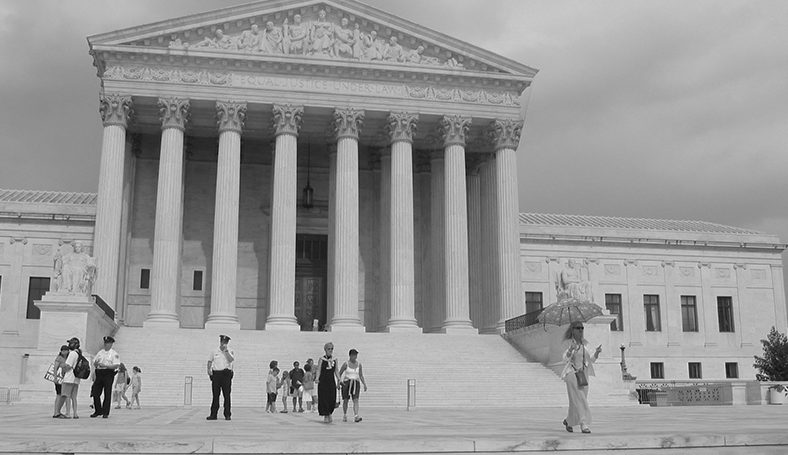
But, today we are going to take a quick dive into a ruling that was delivered late last month by a 6-3 majority of the United States Supreme Court, and which is still making news.
When the ruling was published not quite a month ago, on February 20, it came as a surprise to many SCOTUS watchers, because during much of the president’s time in office—this term and last—the conservatives on the Supreme Court have handed President Trump a string of legal victories, most notable among them, the controversial decision known as Trump v. the United States, with which the Supremes ruled that presidents, namely Donald Trump, have nearly absolute immunity for acts they commit as president.
The ruling we’re exploring today, however, is titled Learning Resources v. Trump, and it is a very different matter.
Here’s the deal.
The 31-page text of the February 20, ruling—which was written for publication by John G. Roberts, the 17th Chief Justice of the United States—explains how and why the series of tariffs—aka taxes—that President Donald J Trump has been enthusiastically levying in recent months via a series of executive orders, he actually has no legal right to levy, impose, demand, or exact.
Donald Trump cannot levy all these tariffs because, according to the U.S. Constitution, Congress gets to tax, but the President does not. Period, full stop.
Yet, aside from the court’s legal conclusion, the most curious element of the 31-page ruling by the Supremes, is the fact that the tone of the written ruling appears to contain a subtle message, which some SCOTUS watchers (including WLA) suggest may be a sub rosa suggestion that Donald Trump’s chaotic policymaking, and personal behavior, along with the behavior of those who do his bidding, is a serious cause for concern that can no longer be ignored.
The president is not pleased
One thing about the ruling is indisputable. The president dislikes it intensely.
First, a few hours after the ruling was released, President Trump held a press conference at the White House, during which he lashed out in very personal terms against the six justices who ruled that the administration’s global tariffs are illegal.
The justices who joined the majority opinion should be “absolutely ashamed” and they lacked the courage to “do the right thing,” Trump said, followed by more statements of that nature.
As the chief executive continued to talk, the attacks grew more personal, with the president’s fury aimed in particular at the Chief Justice, plus two of the three associate justices whom he appointed to the bench, namely Justice Amy Coney Barrett, and Justice Neil Gorsuch, plus the three liberal court members, Elena Kagan, Sonia Sotomayor, and the newest of the Supremes, Ketanji Brown Jackson.
(Note: Justice Brett Kavanaugh, who is the third of the threesome whom Donald Trump appointed to the nation’s highest court, did not support the ruling of the majority but joined with most conservative justices, namely Samuel Alito, and Clarence Thomas, who resoundingly rejected the opinion of the majority.)
The ruling
Okay, now we come back to the ruling that still enrages the 47th President of the United States, to the degree that, this past Sunday, the president volleyed a fusillade of verbal assaults aimed at Chief Justice John Roberts who told NBC News during an interview yesterday, Tuesday, March 18, that this kind of personal criticism of judges “is dangerous.”
Chief Justice Roberts explains it all
The February 20 ruling opens with a rundown on the topic of presidential power, which President Donald Trump clearly appears to view as pretty much limitless.
With that in mind, in composing the ruling, Roberts appears to enjoy writing about the basics of the nation’s historic principle of No Taxation Without Representation.
Here are a few quickie excerpts:
“Article I, Section 8, of the Constitution specifies that the Constitution sets forth the powers of the Legislative Branch,” writes Roberts. “The first Clause of that provision specifies that ‘The Congress shall have Power To lay and collect Taxes, Duties, Imposts and Excises.’
“It is no accident that this power appears first,” Roberts writes. “The power to tax was, Alexander Hamilton explained, ‘the most important of the authorities proposed to be conferred upon the Union.’
‘It is both a ‘power to destroy,’ and a power ‘necessary to the existence and prosperity of a nation…and the one great power upon which the whole national fabric is based’
“The Framers recognized the unique importance of this taxing power,” writes the chief justice—”a power which ‘very clear[ly]’ includes the power to impose tariffs. And [the framers] gave to Congress alone [the ability to] access to the pockets of the people. The Framers did not vest any part of the taxing power in the Executive Branch.
“Congress does occasionally lend its powers to the executive branch,” Roberts adds. “But, when Congress has delegated its tariff powers, it has done so in explicit terms and subject to strict limits.”
The IEEPA issue
This brings us to the matter of IEEPA (a term that most of us have never heard of, but which is much of what the ruling is about, so hang in).
President Trump and company have insisted that he and his administration can get around the vexing fact that the executive branch can’t tax, through the use of a 1977 law called the International Emergency Economic Powers Act—or IEEPA—a legal tool that provides the executive branch the authority to regulate commerce during national emergencies created by foreign threats.
However, according to Roberts and his five fellow justices, while IEEPA can be useful and was created for a reason, it does not give the president the magic wand he claims it does.
“…Against this backdrop of clear and limited delegations,” Roberts writes, “the Government reads IEEPA to give the President power to unilaterally impose unbounded tariffs,”
According to President Trump, continues Roberts, “…all it takes to unlock that extraordinary power is a Presidential declaration of emergency, which the Government asserts is ‘unreviewable….”
Notwithstanding, the president’s assertion happens to be dead wrong, writes Roberts —or words to that effect.
“It is also telling,” writes the Chief Justice, “that in IEEPA’s half century of existence, no [other] President has invoked the statute to impose any tariffs—let alone tariffs of this magnitude and scope.”
“That lack of historical precedent, coupled with the breadth of authority” that the President now claims, means that the tariffs extend beyond the President’s “legitimate reach”
The importance of Youngstown
There is lots more to the 21-page ruling, which features an intriguing line-up of legal precedents that Roberts cites, in order to provide back up each legal point that Chief Justice has made, with plenty of legal precedents. .
“Emergency powers,” writes Roberts on page 12 of his 21 page ruling, “tend to kindle emergencies.” And as the Framers understood, emergencies can “afford a ready pretext for usurpation” of congressional power.
To better explain that problem of potential “usurpation,’ Chief Justice Roberts writes about an extremely well known—and frequent cited—case that deals specifically with the issue of presidential powers, that was decided by the U.S. Supreme Court in April of 1952.
The issue of the limits or lack there-of regarding the powers held by the executive branch, came to the attention of the 1952 Supremes during the Korean War, when President Truman issued an executive order directing his Secretary of Commerce to seize and operate most of the nation’s steel mills, due to the fact that Truman was worried about a strike by the United Steelworkers of America that, if to be allowed to proceed, Truman worried would risk a shut down of much-needed steel production, which was critical during wartime.
The legal question with which SCOTUS was struggling was the question of whether or not the President had the constitutional authority to seize and operate the steel mills.
The majority of the court agreed that, according to the framers, the president did not in fact have such a power.
US Supreme Court Associate Justice Robert H. Jackson was among those on the court 72-years ago, who signed on to the ruling, and was inspired to write a very eloquent concurrence, in which he expressed the importance of further delineating the issue of presidential powers—which includes the relationship between the President’s powers and the powers Congress can exercise.
In the years since, the document known as Jackson’s “concurrence” is where judges and others turn for wise and legally expert thoughts regarding what the nation’s chief executive could and should not legally do.
(You can find some good material on this near legendary piece of writing here.)
And….here’s a small clip from Justice Robert Jackson’s 1952 concurrence where he notes that certain powers that the nation’s forefathers did not give to the chief executive, can be problematic, if that absence of delegation is not explained.
“Not spelling out the fact that certain powers belong to Congress, affords “a ready pretext for usurpation” of the powers of the Congress,” writes Jackson in 1952.
The wrap up…
And so, Chief Justice Roberts writes in the February 20th ruling, the President must “point to clear congressional authorization,” to justify his extraordinary assertion of the power to impose tariffs.
Yet, “he cannot.”
“It stands to reason,” Roberts adds, “that had Congress intended to convey the distinct and extraordinary power to impose tariffs, it would have done so expressly, as it consistently has in other tariff statutes.”
A few pages later, Roberts wraps up the text of the ruling with the following statement about the court and its role in the matter:
“We claim no special competence in matters of economics or foreign affairs,” writes the Chief Justice. “We claim only, as we must, the limited role assigned to us by Article III of the Constitution. Fulfilling that role, we hold that IEEPA does not authorize the President to impose tariffs.”
And that is that.
Concurrences
Okay, we lied. There is one more thing. Concurrences
Trump appointees, Neil Gorsuch, and Amy Coney Barret each wrote ‘concurrences, as did the three liberal court members, Elena Kagan, Sonia Sotomayor, and the newest of the Supremes, Ketanji Brown Jackson.
Each of the concurrences is intriguing.
But, it’s time to finish this story, so we’ll end with an excerpt from the concurrence by Associate Justice Neil Gorsuch.
Gorsuch’s 46-page concurrence makes a number of interesting points, but you’d have to read 46-pages, so we’ll just give you the last paragraph of his concurrence, which sums things up nicely in only 244 words, which we’ve pasted below, and we urge you to read.
Especially the very last line:
For those who think it important for the Nation to impose more tariffs, I understand that today’s decision will be disappointing. All I can offer them is that most major decisions affecting the rights and responsibilities of the American people (including the duty to pay taxes and tariffs) are funneled through the legislative process for a reason. Yes, legislating can be hard and take time. And, yes, it can be tempting to bypass Congress when some pressing problem arises. But the deliberative nature of the legislative process was the whole point of its design. Through that process, the Nation can tap the combined wisdom of the people’s elected representatives, not just that of one faction or man. There, deliberation tempers impulse, and compromise hammers disagreements into workable solutions.
And because laws must earn such broad support to survive the legislative process, they tend to endure, allowing ordinary people to plan their lives in ways they cannot when the rules shift from day to day. In all, the legislative process helps ensure each of us has a stake in the laws that govern us and in the Nation’s future. For some today, the weight of those virtues is apparent. For others, it may not seem so obvious.
But if history is any guide, the tables will turn and the day will come when those disappointed by today’s result will appreciate the legislative process for the bulwark of liberty it is.
****
Post Script: dearest WLA readers, we have some other important stories coming.
So…stay tuned.