The prevailing mood was utter giddiness when the brand new 11,293 square foot LA County library opened on Saturday morning in Topanga Canyon with Supervisor Zev Yaroslavsky and actress (and longtime Topangan) Wendie Malick the duel masters of ceremonies for the speechifying part of the festivities that also featured Pulitzer Prize winning columnist, Al Martinez, and others. Then, just before the ribbon cutting, Henry Smith, a Native American canyon resident of more than 50-years duration, (and a man with a character-sculpted visage well-suited to Mt. Rushmore) gave the building its requisite blessing.
In the past, Topanga residents—in general a community of maniacal readers— had depended on a weekly bookmobile for their library urges. Either that or they found a city library, since the closest county library was in Malibu, too far away for homework forays, especially after school during rush hour.
Nevertheless, after several years of draconian cutbacks in the city’s library system (with disaster averted only when the voters passed Measure L last March), it seemed impossible that the county would actually manage to add a library, what with librarians’ hours getting whacked every time one turned around.
In truth, this new addition to the LA County system had been in the works for over a decade, and broke ground in 2008—right about the time the nation’s economy was collapsing. But once having cleared the land and dug the foundation, it seemed like a good idea to somehow struggle forward.
Still, the place was to have opened in the summer of 2009, but got bogged down with seemingly a zillion set backs. There were the expected money problems, plus the discovery of Native American artifacts on the site, and some issues with the design and….well, nothing seems to be simple in the world of public works.
Plus there’s the fact that Topangans tend to be a meddling group so they wanted to weigh in on everything. (I live in Topanga, so I can say this with affection.)
Despite the hurdles, Yaroslavsky’s office championed the project, and managed to shove it back on track during the instances it fell off. It helped that two of Zev’s field deputies, Susan Nissman and Cynthia Scott, both happen to live in the canyon and were ferociously determined to see the damned thing get built.
As the $19.6 million building neared completion—with its silver LEED certified green construction strategies and its whimsical public art pieces made by canyon artists—locals who had been grousing noisily for months about the library construction crews blocking part of the road, screwing up their work commute, now suddenly were wonderstruck that this sprawling new thing had finally managed to bloom at the canyon’s center, and that it was actually going to belong to everyone.
On Saturday morning, after the speeches had been given, the ribbon was finally cut, and the packed-to-the-rafters crowd and their kids gushed at a near run into the library building itself for the first time, all at once several hundred people became simultaneously goofy with delight, myself included.
In our digital-centric age to see so much obvious happiness over a structure devoted mostly to books, literature and reading—well, it was a very nice thing to behold.
“It’s as if the community finally has a physical heart,” one neighbor said to me, “And it’s a library, of all things! How cool is that?!”"
Very cool indeed.
Okay, now back to our regularly scheduled programming.
EDITOR’S NOTE: The article below is Part Four of WitnessLA’s investigation into the culture of violence and abuse that, for years, has been reported to exist inside the Los Angeles County Jail system—and the dysfunction inside the sheriff’s department that has allowed the abuse to flourish.
(You can find Part One of the series here, Part Two, here, Part Three here.)
LASD insiders say that, for years, Undersheriff Paul Tanaka—not Lee Baca—has ruled the Los Angeles Sheriff’s Department though a system built of favoritism, pay-to-play campaign donations, and loyalty rewarded over competence.
Now he has assumed command of the department’s two internal investigative units—Internal Affairs and the Internal Criminal Investigations Bureau—a move that many close to the department view as a hostile takeover.
On May 15, 2011, the Los Angeles Sheriff’s Department quietly made a series of small, seemingly innocuous changes to its command structure. The Internal Affairs unit, which investigates violations of departmental policy, and the Internal Criminal Investigations Bureau, which looks into criminal acts that may have been committed by department personnel, were taken out from under the oversight of the Leadership and Training Division—where the twin divisions have been for nearly two decades—-and were placed under the control of the then-Assistant Sheriff, soon-to-be- Undersheriff, Paul Tanaka. In practical terms, this meant that, instead of the heads of the two bureaus reporting to Leadership and Training’s Chief, Roberta Abner, Tanaka appointed a brand new captain and commander from his own inner circle to head IA and report to him. At the same time, he selected a new captain to run ICIB, also reporting to him. Abner was taken out of the loop altogether, and a commander position overseeing ICIB was eliminated. Two levels of oversight and accountability in the system with which the department investigated itself vanished overnight.
To the casual observer, the moves might appear to be little more than the bureaucratic shuffling of departmental chess pieces. But to those inside the sheriff’s department, the sudden switch in oversight was alarming. As one former IA investigator explained, “To have a commander and a captain reporting directly to the Undersheriff…there’s no precedent for that.”
In order to check, the LA Justice Report called around to five law enforcement agencies across California—San Diego Sheriff’s Department; Orange County Sheriff’s Department; San Francisco Sheriff’s Department; Los Angeles Police Department; and the San Francisco Police Department–and found that only the SFSD has its “investigative services” unit report directly to someone as high up as the undersheriff without intervening layers. “We’re much smaller than LASD,” explained an SFSD spokesperson, “we only have about 850 employees. So it makes things more manageable.”
In a department of 18,000, like the LASD, the layered chain of command existed for good reason, according to our IA source (and validated by other department insiders with IA knowledge). “Personnel investigations are extremely in-depth. IA is a relatively large unit, with 35-40 people in it. You have to have time to oversee and manage them. But the undersheriff has constantly got an 800 pound gorilla banging on his head.”
So why the change?
LASD spokesman Captain Mike Parker explained in an email that the move was simply so the Sheriff could keep a better eye on the two bureaus. “All reorganization changes within the Los Angeles County Sheriff’s Department are done at the direction of Sheriff Baca…Recent changes have been made to the oversight of Internal Affairs Bureau and Internal Criminal Investigations Bureau to increase accountability and efficiency, and to streamline the process.”
However, sources inside the department say the move had little to do with increased accountability, but rather was a realignment that allowed the undersheriff to protect any of his insiders that needed protecting.
As The LA Justice Report has previously reported, Tanaka has a history of rescuing, promoting and protecting supervisors with less-than-spectacular and often downright troubled performance records, people who then become his most loyal supporters.
There was, for example, Dan Cruz, the highest ranking member of the Sheriff’s Department to be put on leave for his role in the recent jail abuse scandal—and also a Tanaka appointee and loyal donor to the undersheriff’s political campaign in Gardena. Cruz arrived at CJ as an operations lieutenant with a checkered supervisory record. Nonetheless, he was promoted to captain and put in charge of the already troubled Men’s Central Jail. Deputy-on-inmate force incidents spiked almost immediately under his watch. The situation was desperate enough that Cruz’s direct supervisor, Commander Bob Olmsted, told Tanaka directly of problems inside the jail under Cruz—and told Lee Baca as well. Olmsted says he was ignored.
If supervisors like Olmsted came to Tanaka with reports of uncontrolled violence and were waved away, how will the undersheriff respond to critical IA and ICIB investigations into favored people and groups his department?
“I think we should be concerned,” says the ACLU’s Peter Eliasberg. “The reality is that one of the key components in dealing with deputy use of force on inmates is a system that provides for appropriate discipline of deputies. If you have someone at the top overseeing that system who’s not aggressively committed to policing what deputies are doing, that’s a very bad thing.”
KEEP YOUR ENEMIES CLOSER
Part of the problem with the undersheriff’s takeover of the two bureaus, sources tell the LA Justice Report, is the fact that Tanaka has openly, and vociferously, expressed his contempt for IA throughout his career.
In early 2007, LASD Internal Affairs Sergeant Larry Landreth was named the lead investigator of an extremely sensitive case. An LASD deputy trainee had been caught on a wiretap allegedly giving information to the Mexican Mafia. The incident had the makings of a huge scandal for the department, and the brass were all over Landreth to look into this case as quickly and as thoroughly as possible.
Shortly before the investigation began, Paul Tanaka—who was then the assistant sheriff–called Landreth into his office for a closed-door meeting. The meeting began in a normal manner. Tanaka stressed the importance of the case, and gave Landreth his blessing to investigate aggressively.
Tanaka then said something Landreth wasn’t expecting. “He looked at me straight-faced,” Landreth, now retired, tells the LA Justice Report, “and said ‘This is the only time you’re going to see me be an advocate of IA, because I hate you fuckers.’
Startled by the outburst, Landreth scanned Tanaka’s face for a trace of humor but found none.
“You take pride in your job,” says Landreth, “and to be called a ‘fucker’ to my face out of nowhere…It was an affront.”
He asked Tanaka what, exactly, his problem was with Internal Affairs? Landreth and his colleagues had noticed that Tanaka seemed unwilling to promote out of IA–despite the unit being among the most important in the department, and traditionally considered a career enhancing stepping stone in the LASD.
Landreth says he reminded Tanaka that the purpose of IA was far more than proving wrongdoing. It was also bureau in the department with the power to protect innocent deputies who get falsely accused of misbehavior—which happens, says Landreth “all the time.” It is IA’s job to launch the investigations that clear these deputies’ names.
“It is just as important to free the innocent as it is to punish the guilty,” says Landreth.
But Tanaka wouldn’t hear any of it. Pressed by Landreth, Tanaka muttered vaguely that he’d had some bad run-ins with IA back in the 80’s–and that soured him on the unit. He referenced an incident at Men’s Central Jail early in his career, but provided no details.
THE SHOOTING
Tanaka’s worst “run-in” with IA in the 1980s is well known. In 1988 he was the senior officer on the scene when five Sheriff’s deputies shot and killed an unarmed Korean immigrant named Hong Pyo Lee after a car chase found Lee cornered at a dead-end street. The group of deputies fired fifteen rounds at 21-year-old Lee, hitting him 9 times in the back and neck. Tanaka and the other four deputies claimed they shot because Lee was attempting to hit them with his car. However, Long Beach police officer Richard R. Boatwright, who witnessed the shooting, said in a sworn deposition that Lee’s car was moving away from deputies when the shooting began. “We just observed the sheriffs execute somebody,” Boatwright said he told his partner. LA County paid Lee’s family $1 short of a $1 million in a settlement after the shooting.
Then in 1993, sources tell us, Tanaka was reportedly shipped to West Hollywood station as a disciplinary measure for using harsh and inappropriate language to berate a female deputy at Century station, where Tanaka was a lieutenant.
“He’s been carrying a grudge around for more than 20 years,” says Landreth. “That should not be the position of any department head.” And certainly not the man leading the department’s two internal investigative units.
The encounter with Landreth is one of a number of occasions in which Tanaka reportedly badmouthed IA in front of other department personnel. In 2005, Tanaka called a “deputies only” meeting at Century Station in Inglewood, which was, at the time, struggling with violence stemming from a deputy gang called The Regulators—who, like the better known deputy gang of the 1980s to 1990’s era, the Vikings, were notorious for finding weak supervisors they could gang up on and control. Tanaka’s message to this troublesome group: “I never liked IA. Never liked the way they do business.”
“He signs off on discipline,” says a department source familiar with Century Station and the Regulators, “he can’t say that.”
Century’s captain at the time, Steve Roller, agreed—and wrote a memo critical of Tanaka’s statements that he sent up the chain of command. The memo was harsh enough, sources say, that Lee Baca himself visited Century to do damage control.
A few months later, Roller was unexpectedly transferred out of Century while away on an Alaskan cruise. Several sources tell The LA Justice Report that it was the captain’s aggressive, by-the-books ways that got him ”rolled up”—as it was a supervisory style that clashed with Paul Tanaka’s vision for how to run a high profile station like Century.
As we reported in Dangerous Jails, Part 3, department sources cite multiple incidents in which Undersheriff Tanaka has told deputies in the department to “work in they grey”—a skate the edge style of policing that essentially translates to “do whatever it takes.”
The LA Justice Report spoke with three former IA investigators who each made clear that “working in the grey” policing, and aggressive internal affairs monitoring of departmental wrongdoing are irreconcilable. Robust internal affairs and deputies told by their undersheriff to push the boundaries of departmental policy cannot coexist. Something has to give. And by all accounts, when it comes to Paul Tanaka, it will be IA, not the deputies under his wing who are forced to cede ground.
HANDCUFFING THE ADULTS
An example of the slippery slope that comes with ceding this supervisory ground occurred in 2006, when Paul Tanaka called an impromptu meeting for all the supervisors inside Men’s Central Jail. Tanaka was then the assistant sheriff in charge of custody and the meeting was not unexpected. There had been a string of high profile violent incidents in the jail that had drawn the scrutiny of the LA County Board of Supervisors, the ACLU and the media.
As The LA Justice Report has previously reported, CJ’s then-captain John Clark traced much of the violence back to bands of deputies who were forming gang-like cliques on the second, third and fourth floors of the jail—the 3000 Boys, et al. Modeled after the law-suit producing deputy cliques of the previous decades, like the Vikings, these cliques featured special tattoos, threw gang-like hand signs and, in some cases, refused to socialize with “rival” cliques within the department. In the case of the 3000 Boys and the matching group from the 2nd floor, the 2000 Boys, the cliques had also recently started waiting for their entire crew to get off work—sometimes lingering for hours at a time—before leaving the station together en masse. This was not only a violation of departmental policy, but it was eerie gang-like behavior intended to intimidate—to show both inmates and supervisors alike who really ran the jail.
“You had guys taking off one or two hours early so they could leave with their crew,” says one former CJ supervisor (who asked that we not give his rank for fear of being identified). “This is what gangs do.”
It was in this climate, that Paul Tanaka called his meeting. Our source, who was in the room that day, tells us that, instead of demanding better supervision of the increasingly out-of-control deputies—whose actions have now been reported by The LA Justice report here, along with the ACLU, the LA Weekly, KTLA and the LA Times, not to mention an ongoing series of high ticket law suits, and an investigation by the FBI—Tanaka told everyone to back off.
“I want you supervisors to stay out of the way and let the deputies do their jobs,” Tanaka said. “Your type of supervision is like a dinosaur. You remind me of my father.”
Our source says Tanaka was particularly livid at the suggestion that deputies in cliques like the 3,000 Boys were acting like gangsters. “How dare any supervisor refer to a Los Angeles Sheriff’s Department deputy as a gang member.”
Tanaka then made a cradling gesture with his hands. “This is Generation Y. You will coddle these men.”
Our source says that he and his fellow CJ supervisors were shocked at the counter-disciplinary instructions. Here was one of the most powerful men in the department essentially telling them to not do their jobs—not to provide boundaries, and guidance for these inexperienced deputies. Many of these men and women were a few months out of the Sheriff’s Academy and were not just risking doing harm to inmates, but also—if their mistakes were big enough— potentially sacrificing their careers. This is why a big law enforcement agency like the Los Angeles Sheriff’s Department has structural fail safes: Just because the assistant sheriff wanted lax supervision, didn’t mean IA or ICIB couldn’t investigate these same deputies for wrongdoing, if their actions were serious and well documented.
.
“We weren’t trying to be autocratic,” says our source. “We’re a paramilitary organization. There are rules and regulations. We need discipline. And that discipline had broken down.
“Tanaka’s intervention put handcuffs on all of us.”
Sources tell us Tanaka’s hands-free management style is nothing new—it dates back to his days as a sergeant at Lynwood station in the late-80’s early 90’s. According to a source who worked at Lynwood, Tanaka was the supervisor of choice for deputies who were “sergeant shopping”—looking for a supervisor mostly likely to give permission or protection. This was particularly true with members of the Vikings, of whom Tanaka was, by then, a tattooed member.
[For more on the undersheriff and the Vikings see the sidebar below]
Since Tanaka was just a sergeant, back then, he wouldn’t have had the “juice” to head off something as serious as an IA investigation. But in basic disciplinary battles between deputies and fellow sergeants, Tanaka nearly always sided with deputies—in the process, eroding the authority of supervision at the station.
“He was emotionally close with these guys,” explains our source. “They bonded. He was one of them. He was too immature and not intellectually aware enough to realize the inherent problems with this arrangement. Departmental standards were not being enforced.”
“They’d go running to him like Mommy,” says another LASD source from Tanaka’s Lynwood days. “Tanaka sold out his fellow supervisors to curry favor with the Vikings. It breeds arrogance on steroids. Because these guys know, even if they’re in the wrong, someone has their back. It’s the same story today with the 3,000 Boys. This is a pattern with Tanaka.”
CONTROL ISSUES
So why does a man who has repeatedly made known to all his dislike of Internal Affairs, and aggressive supervision of deputies, suddenly wish to have power over over the unit responsible for investigating departmental misdeeds?
The three former LASD Internal Affairs investigators we spoke to all told us versions of the same thing: “It’s about control.”
These former IA investigators, as well as other sources inside the department, point to the questionable timing of Tanaka’s takeover—a few weeks after his high school friend Bernice Abraham was put on leave when federal investigators notified Sheriff’s officials that Abram’s voice may have been heard on a narcotics wiretap relating to an investigation of a Compton drug ring. Abram had been the head of Carson Station and a close ally of Tanaka. She has contributed to his Gardena political campaigns since 2004.
“Ever since Abram was relieved of duty, things changed,” says one LASD supervisor.
According to the supervisor, prior to Tanaka’s takeover of IA and ICIB, whenever someone in the department was arrested or put on leave, a departmental memo called a “confidential operational log,” which summarized the circumstances surrounding the action, would go out to LASD supervisors with the rank of captain or higher. However, a confidential operational log was never sent out about Abram, nor, according to our insider, have any others been sent since Tanaka became Undersheriff.
“People inquiring about [Abram], mostly out of concern, were quickly told to ‘mind their own business.’
“All this did was weaken trust within the department,” he says. “There was no more transparency and many felt, and feel, that there is something to hide, not only as it relates to Bernice Abram, but to others and any potential future investigations.”
“It was standard operating procedure, no big deal,” says another former LASD higher-up of the confidential operational logs, “the way business was done. Now it’s all about trying to stifle information from getting outside the organization.”
DOUBLE STANDARDS
Multiple sources tell us they worry there is a standard of permissiveness for some people—namely Tanaka insiders—-that doesn’t apply to others in the department. They argue that there were instances of the Undersheriff and other LASD brass applying pressure on IA investigations even before Tanaka took direct control of the bureau. As an example, they point to an investigation into the May 9, 2005 shooting of Winston Hayes by LASD deputies. Hayes was a black motorist who, high on drugs, led Sheriff’s deputies on a low-speed pursuit through Compton. Deputies eventually pulled Hayes over, and advanced in his direction. Then, claiming he tried to run them down, deputies fired 120 shots at Hayes’ car, hitting him nine times and his vehicle 66 more times. In the crossfire, the deputies also managed to shoot one of their own officers (non-fatally), plus strafe several squad cars with 11 rounds. Another 11 bullets slammed into surrounding homes.
The incident prompted a gigantic community backlash and cost LA County $1,326,468.60 when a jury, after watching a citizen video of the incident, agreed that officers had used excessive force on Hayes, who miraculously survived the barrage. All deputies involved in the incident were given 15-day suspensions stemming from an Internal Affairs review, as was the sergeant who directed the chase over the police radio.
Yet two different sources tell us that the watch commander on the incident, a lieutenant out of Compton station, not only escaped any kind of sanctions, he was never made a subject of investigation by Internal Affairs—despite the fact that he was in the field and on the radio during the chase. According to our sources, this lieutenant upped the urgency of the chase by hopping on the radio to list Hayes’ past crimes as events were still unfolding.
“He absolutely inflamed the situation,” says one LASD insider with knowledge of the incident.
Sources say IA investigators attempted to interview the lieutenant as a subject, but were pressured by higher-ups to stay away. Landreth was one of the lead IA investigators on the Compton shooting, and he confirms our sources’ story. Departmental policy and the Policeman’s Bill of Rights prevent Landreth from discussing the case with us in detail, or naming the lieutenant in question, but other sources tell us the lieutenant was James Hellmold—one of Paul Tanaka’s leading campaign contributors and a former driver to Sheriff Lee Baca.
“Tanaka and Baca put Hellmold off in the corner and let the Sergeants take the fall,” says a former high-ranking insider with knowledge of the situation. “He absolutely should have been the subject of an IA investigation.”
Hellmold’s free pass earned him the nickname “Teflon Lieutenant” among those with knowledge of the shooting. A little more than a year after the incident, Hellmold was promoted to captain and placed in charge of Century Station. He has since risen to the rank of commander and is one of four commanders leading Baca’s panel to investigate jail violence.
However, Hellmold’s Teflon dodge happened under the old IA system–where an investigator like Landreth had the option going to his chief to try to earn the backing of a command staff ally. Under the new system, the only recourse an investigator would have would be to go straight to Paul Tanaka.
“If he’s stacking the deck with ‘his’ people in there,” says one former Internal Affairs investigator, “then I don’t have any faith in IA.”
EPILOGUE
On December 19 of 2011, the LA Justice Report submitted a series of questions to the LA Sheriff’s Department regarding Paul Tanaka’s takeover of Internal Affairs and Internal Criminal Investigations Bureau—and his notorious dislike for IA.
On January 4, 2012, two weeks after our conversation with Parker, Internal Affairs was put back under the umbrella of Chief Roberta Abner and the Leadership and Training Division. Internal Criminal Investigations remains under the control of Undersheriff Tanaka. How much or little unofficial influence over Internal Affairs that Paul Tanaka retains is unknown.
Editor’s Notes:
TANAKA & THE VIKINGS
In 1987, the year before the Hong Pyo Lee shooting, Paul Tanaka was asked to join the Vikings, the now notorious group of deputies operating out of the Lynwood station, whose members sported numbered Viking tattoos on their ankles, threw gang signs—L for Lynwood—occasionally spray-painted Vikings tags in the Lynwood area to mark their “turf,” and bragged openly about harassing supervisors who tried to reign them in until those supervisors transferred away from Lynwood. Tanaka was one of the group’s very few non-Caucasian members.
In the early 1990’s, members of the same Lynwood Vikings were the primary defendants in a massive class action suit against the department alleging a widespread pattern of brutality against Lynwood residents.
The suit resulted in a $9 million settlement and drew unusually harsh “findings of fact” from two sets of presiding judges.
U.S. District Court Judge Terry Hatter stated that a “neo-Nazi, white supremacist gang” of deputies–the Vikings–exists at the Lynwood station with the knowledge of department officials. “Policy makers” in the department, Hatter said, “tacitly authorize deputies’ unconstitutional behavior.”
The 9th Circuit Court of Appeals agreed. These deputies, wrote the 9th Circuit of the Lynwood Vikings, “…regularly disregard the civil rights of individuals they have sworn to protect.” They engaged in misconduct “both malicious and pervasive…” Black and hispanic men were “repeatedly arrested without cause and severely beaten at the Lynwood station, the County jail, and the ‘Operations Safe Streets’ trailer.” The court described “instances where deputies placed the muzzle of a firearm in a suspect’s ear, mouth or behind his head, and threatened to pull the trigger, or actually fired the gun without discharging a bullet…” and more.
The list of court-determined “facts” went on and on..
Tanaka was already a Viking at the time the lawsuit was filed, but was not one of those named in the complaint. However, we spoke to two of the attorneys who filled the lawsuit, as well as to department insiders with direct knowledge of the Vikings, all of whom confirmed Tanaka’s involvement with the group during his Lynwood years.
“[Tanaka] was well known as a member of the Vikings and what they stand for,” said former LASD lieutenant, Roger Clark. Now retired, Clark acts an expert witness who is frequently called to testify about his knowledge of law enforcement subcultures and what he calls “peer clans,” like the Vikings and the 3000 Boys. “There’s always been a tension in the department between people who are willing to bend the rules and those who are not.” Undersheriff Paul Tanaka, said Clark, falls firmly on the rule-bending side of the equation.
DANGEROUS JAILS – PART 5: COMING NEXT MONTH
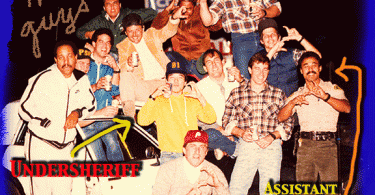
THE PHOTOS: From Top to Bottom: Paul Tanaka, Cecil Rhambo and fellow deputies at the Carson Station flashing “C” for Carson, circa early to mid 1980s; 3000 Boys from Men’s Central Jail flashing their “3″ sign; frame of citizen’s video of Lynnwood deputy flashing Viking sign, “L” for Lynwood, circa late 1980s.
On Wednesday morning, The ACLU of Southern California filed a federal class action suit against the Los Angeles Sheriff’s Department with the idea of getting a sharp-toothed federal injunction that will force the department, at legal gunpoint, if necessary, to make the changes necessary clean up its desperately troubled jails.
The suit makes it clear that it’s not looking merely for symptomatic tinkering, that it views the problems as systemic, and that they start at the top.
With this in mind, in addition to suing the LASD in general, the suit charges that Sheriff Lee Baca, Undersheriff Paul Tanaka, Assistant Sheriff Cecil Rhambo, and former Chief of Custody Operations Dennis Burns all knew about “a longstanding, widespread pattern of violence by deputies against inmates in the county jails” —but when confronted with the abuse by concerned supervisors (as we reported here and here and here in Matt Fleischer’s Dangerous Jails series), Baca, Tanaka and company basically told the supervisors to buzz off—and the abuse was allowed to continue.
The 77-page complaint details an avalanche of horrific alleged incidents of inmates being slugged, tased, kicked, head-bashed, slammed and, in one case, scalp-carved by deputies—with several of the reported incidents occurring in front of witnesses, or while the inmate was handcuffed, or both. Many of the beatings reportedly resulted in multi-day hospital stays and permanent injuries.
At a press conference Wednesday morning, So Cal ACLU legal director, Peter Eliasberg, and Margaret Winter, the associate director of the ACLU National Prison Project, both said they expect the lawsuit to result in a federal injunction—likely in the form of a consent decree—- that will force the LASD into “real accountability.”
When I asked Winter whether or not she thought the ACLU had a good chance of getting the desired injunction, Winter answered strongly in the affirmative.
“I have really seldom felt more confident that litigation is going to result in a consent decree.” she said. “I mean, we have massive evidence even before discovery. And during the discovery phase of all this, we’re going to get everything. Everything. ”
(Just in case you’ve forgotten, discovery is the period of formal investigation — governed by court rules — that is conducted before trial. At that time one party may force the other to produce requested documents or other physical evidence, even if the second party really would rather not.)
Until very recently, said Winter, the department refused even to fork over its guidelines for use of force inside the jails. “We tried for years to get that.”
(For the record, I know from personal experience that one can easily get this kind of information from the LAPD, while the Sheriff’s Department is bothersomely withholding about trivial things.)
“Now [through the discovery process] we’re going to open the book and go into all the dark corners of the jails and shine a light on the fantastic secrecy that’s been the rule in the past.”
In reading over the just-filed 77 pages of the “Complaint for Injunctive Relief”—known formally as Rosas v. Baca— it does appear that the ACLU already has a lot of potent ammunition to get the court’s attention.
Some random examples of the allegations include:
In July 2011, two deputies beat a handcuffed inmate about the head and neck, the beating so severe that he required hospitalization outside the jail, and has permanent hearing loss in one ear.
In March 16, 2011, three deputies beat an African American inmate until he was unconscious then carved the letters M – Y into his scalp, the first two letters of “MYATE,” (or more commonly “MAYATE,”) a racial street slur meaning “black.”
In March 2011, deputies slammed a handcuffed inmate’s head into a cement wall, leaving him with a concussion and a gash that took 35 stitches to close, then beat him around the head and face when he came to, resulting in 2 days of hospitalization and four additional days in the jail’s medical unit. The ACLU reports that were several witnesses to this incident.
In February 2011, deputies severely beat a mentally ill inmate who was in jail on two warrants: for failure to pay his subway fare, and driving without a license. The beating resulted in a collapsed lung, two broken ribs, a nasal fracture and four broken teeth.
The list goes on from there, including the alleged 2008 rape by a deputy of Frank Mendoza, who was in LA County jail on a charge of public drunkenness. (That’s Mendoza in the video above.)
These are, of course, only allegations. But there are a lot of them. And included in the filing are accounts from a list of civilian witnesses, including two jails chaplains, and a former FBI agent.
LASD Commander James Hellmold was present at the press conference and answered reporters’ questions afterward. (Interestingly, Hellmold admitted he’d not been invited by the ACLU to the Press Conference, but saw a PR release announcing its existence, and simply decided he’d show up, like the rest of us, to find out what was being said. We, in the press, of course, were delighted that he chose to do so.)
In response to inquiries about the alleged beatings, Hellmold said that he “hoped deputies would be given the same courtesy given the inmates, of being considered innocent until proven guilty.”
(Winter said later, than if any deputies weren’t given due process, she guaranteed she’d be the first in line to bring suit to defend their constitutional rights.)
About the reported “culture of violence” inside the jail system, Helmold said that there was “a culture of violence,” inside the jails, but that it was “among the inmates,” more than half of whom he said, “are in jail on violent charges.”
When pressed on the topic by a TV reporter who asked what he thought about the sign-throwing, tattoo-sporting deputy gangs inside the jail, groups like the now-infamous 3000 Boys inside the jails, he said, “I have no comment.”
Hellmold is one of the three recently promoted commanders who are heading up the Sheriff’s special task force that was formed last fall to look into the accusations of inmate abuse by deputies. (As we have reported in the past, Hellmold is also part of Undersheriff Paul Tanaka’s inner circle, and a longtime donor to Tanaka’s political campaign outside the department. We also reported that Paul Tanaka was the one who was repeatedly obstructive when concerned department supervisors tried to institute reforms to curb the deputy on inmate violence.)
Oh, and Hellmold was one of those who told the LA Times back in October that reports on jail violence never reached the Sheriff.
Bring on the lawsuit—and the discovery.
PS: Matt Fleischer and I were happy to note that loads of material from our Dangerous Jails series was woven all through the ACLU’s 77-page lawsuit. (Just thought you’d like to know.)
While WitnessLA didn’t go dark on Wednesday for the SOPA blackout (too much jails stuff going
on to even consider it), the protest seems to be helping.
If you’re unfamiliar with the fuss about SOPA—the Stop Online Piracy Act—and its little sister PIPA …. the Protect IP Act, let writer and NYU professor Clay Shirky explain it all to you.
Shirky, who is one of the smartest people breathing on all things web, was asked to do an “emergency TED talk,” to address the issue of SOPA (and PIPA) in plain terms.
A big ACLU press conference on the Los Angeles Sheriff’s Department and the LA County Jails is scheduled for Wednesday morning, thus we’re holding our Dangerous Jails story until Friday so that the two don’t collide.
More on the ACLU’s announcements after the press conference.
In the meantime, the LA Times reports that Gilbert Michel, the Sheriff’s deputy who pleaded guilty to bribery last week, is cooperating with the FBI and has some whistles to blow on other deputies working in the jails.
On one hand, this is not exactly new news, as it was made clear in the plea agreement that cooperation was part of the deal, and that Michel had info to share. But Times reporters Robert Faturechi and Jack Leonard wisely went to Michel’s court date on Tuesday and got some additional details, which were quite interesting, like the fact that Michel, while he takes full responsibility for his stupidity, feels that he’s being hung out to dry by the department as the only bad apple, when there’s a whole barrel full of bad apple deputies who were engaged in abuse and misconduct, And that he Michel, will be sharing what he knows with the Feds.
Michel’s attorney added that more deputies were guilty of misconduct and that “supervisors were overlooking it.”
Yep. That’s what we’ve been saying, and will keep saying.
Much has been made about the fact that L.A. County Sheriff’s Deputy Henry Marin, who is charged with smuggling a heroin-crammed burrito into a courthouse jail, may have been a less-than ideal prospect for the Sheriff Department—at least according to his bumbling and inattentive performance on the Fox reality show “The Academy.” The show, which began airing in May 2007, followed two different classes of Sheriff’s Department recruits through their training process. Marin, it turned out, did so badly he was cut from the first class of recruits after a televised failure to pay attention in a crucial exercise. Later Marin was given another chance—and was able to join the department. (The LA Times has more on Marin and his ill fated career as a reality star.)
His poor performance as an LASD recruit, combined with his recent arrest for alleged drug smuggling, has caused questions to be raised about the efficacy of the department’s screening and training of young deputies who, right after graduation, are assigned custody duty in one of the the county’s troubled jails.
The concern may be well founded. WitnessLA has learned that, in June and July of 2007, shortly after Marin was expelled from his training class, the state Commission on Peace Officers Standards & Training (POST), the agency that certifies law enforcement academies, visited the Sheriff’s Academy to make its annual report—and it was a doozy.
What they found and documented in their confidential 29-page report (which was, at the time, obtained by the Daily News) was so alarming that, in May 2008, Sheriff Lee Baca took the unprecedented step of shutting down the training academy for a full month so that the department could address the problems.
Among the violations that POST inspectors documented, according to the Daily News story, were instances of instructors giving cadets the answers to test questions, and allowing cadets to take driving tests and other physical exams multiple times, until they could finally pass—all of which is strictly against state guidelines.
“Significant test security issues were identified during the certification review,” the authors wrote. “In one instance, the (training officers) staff was reportedly directed to take a test into the classroom and give the answers to the students.”
The report also said inspectors heard anecdotal reports about students who were not required to pass the physical-conditioning sessions and who failed firearms and driving tests and were retested multiple times.
Remember, it is these same poorly prepared cadets from the 2007-2008 classes who were funneled directly into guarding the jails, where they often received inadequate supervision. Worse, as WitnessLA has documented in Matt Fleischer’s Dangerous Jails series, when strong supervisors attempted to step in and give the young deputies firm boundaries—or tried to sanction them when they misbehaved—force reports were neglected and reform-minded supervisors were asked by command staff to back off.
Q. There has been some trouble especially in Men’s Central Jail. Former commander Robert Olmsted has emerged as one of your toughest critics. He said in a recent LA Times interview, that he tried to warn you that deputies were getting away with using unnecessary force, beating up inmates. He says you ignored his warnings. What do you say to his allegations?
[Well], his allegation is completely out of context. I knew of the force issues, because of six deputies that got into a fight at a Christmas party. He tells me after I learned already. That’s not a very good warning. He should have told me before he retired. And that’s my response to his concern. He and I spoke. He told me he tried to warn his supervisors, but when I spoke to his supervisors, they said he didn’t try to warn them. So, the guy strikes me as being a little odd. If he knew about these things, why didn’t he tell me while he was working there instead months later when he is retired and left the department.”
Q. Maybe he was afraid that there would be retribution if he came forward before his retirement?
Well, he should be strong enough to understand that anything that is under his command, he has the responsibility to correct himself and not blame others above him.
Q. But in one way or another, there was a communications error and the information did not reach you in a timely manner?
That’s correct.
Q. You mentioned the Christmas party brawl between the deputies. Those were the deputies who worked at Men’s Central jail?
Correct, which Robert Olmsted was the captain there and he was also a commander over that captain. So, it was totally in his control. If he knew about this, he should have done something.
Q. KTLA did a report about the so-called 3000 block gang of deputies, who have their own hand signals just like members of street gangs. Those were the deputies who got into this Christmas brawl. How have you dealt with?
Well, those deputies, first of all, they were not a gang. And secondly, they didn’t have hand signals for themselves. They took a photograph off duty and used what were commonly thought of as gang type signals. But it is not a fact that they were operating like a gang in jails. We don’t have gangs in county jails. Every deputy has specific assignments. They don’t work together as a group. They are spread out to all the different cells. So, they were friends. The KTLA report with even the allegations that they were a gang are completely false. They were just new deputies assigned to the sheriff’s department – been on for 2,3 years. You don’t have a chance to form a gang under those circumstances. So, my answer to this is that the news took it upon themselves to make this sound like this is worse than what it really is. Nonetheless, I fired six of the deputies for getting into the fight. You initiate a fight, that’s unacceptable. That’s where they made their mistake and now they are gone.
Q. The former commander Olmsted also claimed that in Men’s Central Jail there was a culture of disobedience – writings on the office walls saying “don’t feed the animals”, things like that. Have you heard of this kind of a culture prevailing in Men’s central Jail?
It’s not a culture as much as it is an act of wrong doing by – who knows who. When this happened, commander Olmsted was the captain of the Central Jail. He should have done a criminal investigation. He did not. He basically said, let’s just fix the problem in terms of painting over graffiti. A report was made, but in my opinion a crime report should have been initiated. And in that place we would try to find out who did this and then severely discipline this person who did it. So, you see, a few mistakes have been made along the way. But this is not me trying to be critical of commander Olmsted, but at the same time I rely on captains and commanders to fix problems. And it appears to me that commander Olmsted, then captain Olmsted didn’t fix the problem to the extend that he should have. That’s all I’m saying.
Q. So, have you looked into this “don’t feed the animals” signs and other forms of disobedience, or wrong doing?
I have, but you cannot go back three years and say, we sufficient timeliness. It should have been done at the time it was discovered, when Olmsted was captain. He should have commenced a criminal investigation.
Q. I have seen some reports, where inmates have come forward, who have said that they have been beaten up by the deputies in the jail system. Is that still happening?
Inmates say they’ve been beaten up, but they don’t say, what were the circumstances in which they were involved in fights with deputies. It’s easy to say that they were beaten up, but those who have not reported the force – the deputies are supposed to report all the force they use – we discharge those deputies who don’t report all the force. No one has been harmed to the extent that they are permanently incapacitated, or even killed in the hands of deputies. The biggest concern that the inmates have is other inmates attacking them. Most of the fights that the deputies get into are provoked by the inmates. But I do believe that we can do a better job. That’s why I have a force prevention policy, because some of the inmates, who the deputies themselves have used the force, tell me, are people, who have mental issues. And they don’t have any context as to how to control themselves. So, when the deputies try to move them from one place to the other, whey resist and then force is used and then there is a fight. Of course, let me make clear that in a jail operation, where inmates are violent, the deputies must always win. If we don’t have control a hundred percent during fights, we wouldn’t have anyone that we would be able to protect within the jail system, particularly inmates on inmates. So, every inmate that attacks a deputy or gets into a fight with a deputy, is ultimately going to lose. That’s the reality. And for some that have lost, they say, I was beaten up. But they never say what they did to strike the deputy…..
Um…..one hardly knows what to say.
So instead, I would recommend that you read what the ACLU will announce at its press conference at 10:30 a.m. this morning (Wed. morning.) It’s embargoed until then, but I’ll be putting it up in a separate post, immediately after the embargo is lifted.
The cover story in Sunday’s New York Times Magazine is a profile of Judy Clark, one of a group of militant radicals who, in 1981, tried to rob a Brinks truck and ended up killing two police officers, and one of the Brinks guards, before getting caught. Clark was one of the getaway drivers for the group. As it turned out, she was an inexperienced and untalented driver and so managed to smash the car in which she and two of her crimeys were escaping into a concrete wall, at which point she and they were arrested.
Clark compounded her mistakes by insisting upon representing herself in trial and hectoring the jury with phrases like “Revolutionary violence is necessary, and it is a liberating force.”
As a consequence, she was sentenced to 75 years in prison—more than several of her co-defendants, most famously, Kathy Boudin, who let her private attorney do the talking. Boudin got 20 to life, and is already out, while Clark has thus far done 30 of her 75-year sentence.
The NYT Mag story on Clark and her subsequent “transformation,” written by former Village Voice investigative reporter, Tom Robbins (not to be confused with the novelist), is clearly intent on making the case for Clark’s release, without actually saying as much. Robbins, who knew Clark in her pre-Brinks robbing days, is much too smart a journalist to be that obvious (even if the NY Times editors would go along with it, which they wouldn’t). Instead, he makes the case that she has changed profoundly. And certainly by all accounts Clark seems to be a very positive force at Bedford Hills, the maximum security women’s prison where she has been for the past three decades.
As Robbins notes, Clark has drawn to herself a long list of people pleading for clemency in her behalf, several of whom are very persuasive.
Speaking personally, however, I find I have a slew of mixed feelings about this matter.
Sure, I believe the warm looking, grey-haired, school-teacherish white lady has likely done enough time. Moreover, many of the prison officials who know her well describe her potential as a positive force who could better contribute to society on the outside, rather than being locked up on the public’s dime.
And the truth is, we incarcerate way too many people in this country for way too long. It is a practice is corroding our collective soul as well as our state budgets.
But—again just speaking personally—there are quite a number of people I’d put on the clemency list ahead of Clark. Yet none of them happens to be a cozy-smiled, well-educated, white woman.
They are instead former gang members whom we are content to put on the throwaway list.
(I’d wager that most working public defenders have their own special shortlist of former clients they’d put on the clemency list. Ditto prison chaplains, and so on.)
One more thing: I’d have felt a lot more comfortable with Robbins’ article if he and the Times’ editors thought to spend just a paragraph or two on the three victims: Edward O’Grady, Waverly Brown, and Peter Paige—all of whom had kids.
I’m just sayin’.
AND WHILE WE’RE ON THE TOPIC OF RACIAL DISPARITIES IN INCARCERATION….LEGAL SCHOLAR MICHELLE ALEXANDER EXPLAINS THE NEW JIM CROW
In the last two years, Michelle Alexander’s important book, The New Jim Crow: Mass Incarceration in the Age of Colorblindness, has been the #1 must read for criminal justice advocates.
Monday, NPR’S Fresh Air ran an interview with Alexander for Martin Luther King Day. The broadcast is worth listening to in its own right. And, by happy coincidence, it is also a good contextual framework with which to view the NY Times Judith Clark story.
Under Jim Crow laws, black Americans were relegated to a subordinate status for decades. Things like literacy tests for voters and laws designed to prevent blacks from serving on juries were commonplace in nearly a dozen Southern states.
In her book The New Jim Crow: Mass Incarceration in the Age of Colorblindness, legal scholar Michelle Alexander writes that many of the gains of the civil rights movement have been undermined by the mass incarceration of black Americans in the war on drugs. She says that although Jim Crow laws are now off the books, millions of blacks arrested for minor crimes remain marginalized and disfranchised, trapped by a criminal justice system that has forever branded them as felons and denied them basic rights and opportunities that would allow them to become productive, law-abiding citizens.
…THEN ON THE ISSUE OF PEOPLE GETTING OUT OF PRISON IN GENERAL…..
Former Daily News editor of the Daily News, Ron Kaye, wrote an Op Ed for the Glendale News Press about his friend Nyabingi Kuti, a community organizer and activist with the MLK Coalition, who is working to bring together reentry services and programs for those getting out of prison.
Here’s a clip:
…..the governor’s “realignment” plan that started Oct. 1,…has a lot of people worried that it will trigger a huge surge in crime after years of decline. After all, without effective rehabilitation programs re-entry into society is tough, which is why we have a 70% recidivism rate.
Many local politicians and law enforcement officials figure are howling for more money to hire more cops and build more county jails.
But others like Nyabingi {Kuti] are working hard to develop alternatives to jail and tough policing to actually turn realignment into a creative opportunity to bring resources together to help the “formerly incarcerated” — a preferred term for ex-convicts — stay out of trouble and lead productive lives.
Right—which is exactly what realignment can be—a creative opportunity. Let us hope more people in the city and county see fit to similarly rise to that challenge.
AND…LAST BUT NOT LEAST: THE LA TIMES CALLS FOR A CHRISTOPHER COMMISSION FOR THE COUNTY JAILS
It’s good that an LA Times editorial calls for a thorough review of the situation in the LA County Jails by the new Citizen’s Commission—a la the Christopher Commission.
(I believe that’s what WitnessLA called for early last March, but okay, why quibble?)
But then the Times editorial goes on to say….nothing new. They say that the commission “….could determine whether the deputy culture inside the lockups is part of the problem. It could consider whether rookie deputies, whose first job out of the academy is as jailers, receive appropriate supervision. And it could identify the shortcomings that allow excessive use of force to go unpunished….”
Y’think??? What the Times fails to mention, and what WitnessLA has repeatedly pointed out, is that the root elements that have allowed all of the above problems to flourish begin well upstream of the symptomatic issues that the Times ticks off.
Fortunately, I think there are at least a couple of people on the commission who know where and how to look beyond the symptoms.
Photos of Judith Clark: (right) Nan Goldin for The New York Times. (left) Associated Press.
A former Los Angeles County Sheriff’s deputy was charged today, Friday, with agreeing to accept $20,000 in bribes in exchange for smuggling contraband to an inmate inside the troubled Men’s Central Jail, the facility that has been ground zero for the inmate-abuse-by-deputies scandal.
The case against Gilbert Michel, 38, was announced by United States Attorney André Birotte Jr. and Thomas E. Perez, the Assistant Attorney General for the Civil Rights Division.
Michel was of course the guy whose arrest for smuggling in a cell phone at the behest of the FBI’s confidential informant got Sheriff Baca all in a lather. (Baca has since backed off and stopped blaming the people who caught the lawbreaking, bribe-taking deputy—rather than the deputy himself.)
In a plea agreement also filed Friday, Michel agreed to plead guilty to the charge and to cooperate in an ongoing investigation.
Michel, who resigned from the Los Angeles Sheriff’s Department in September 2011, was assigned to the Men’s Central Jail in downtown Los Angeles.
In the plea agreement, Michel admits that he agreed to accept $20,000 in cash in exchange for smuggling contraband into the jail for delivery to an inmate. The contraband included a cell phone, cigarettes and a note – which in jail parlance is called a “kite.”
The inmate, as it turned out, was a confidential informant for the Feds.
Moreover, according to the plea agreement, the dollars for contraband deal wasn’t a one shot. Michel. it seems agreed keep charging the phone for the inmate, holding the phone for safe keeping when he (Michel) went off shift, then returning the phone to the inmate/informant when the deputy came back on—each time for a hefty payment, which the informant/inmate made clear was from money obtained by illegal means.
The bribery charge carries a statutory maximum penalty of 10 years in federal prison.
The case against Michel is part of an ongoing investigation being conducted by the FBI, thus the plea deal in return for cooperation is considered significant by LASD watchers.